He's fine while you're home. Then the door closes.
Howling until the neighbors knock, a door frame chewed down to the wood, a puddle in the hallway from a dog who has been house-trained for years. That isn't spite. It's panic about being alone, and panic can be trained in steps small enough for your dog to handle. Your coach makes a 30-day plan around your dog and your week, starting with absences so short he barely notices you're gone.
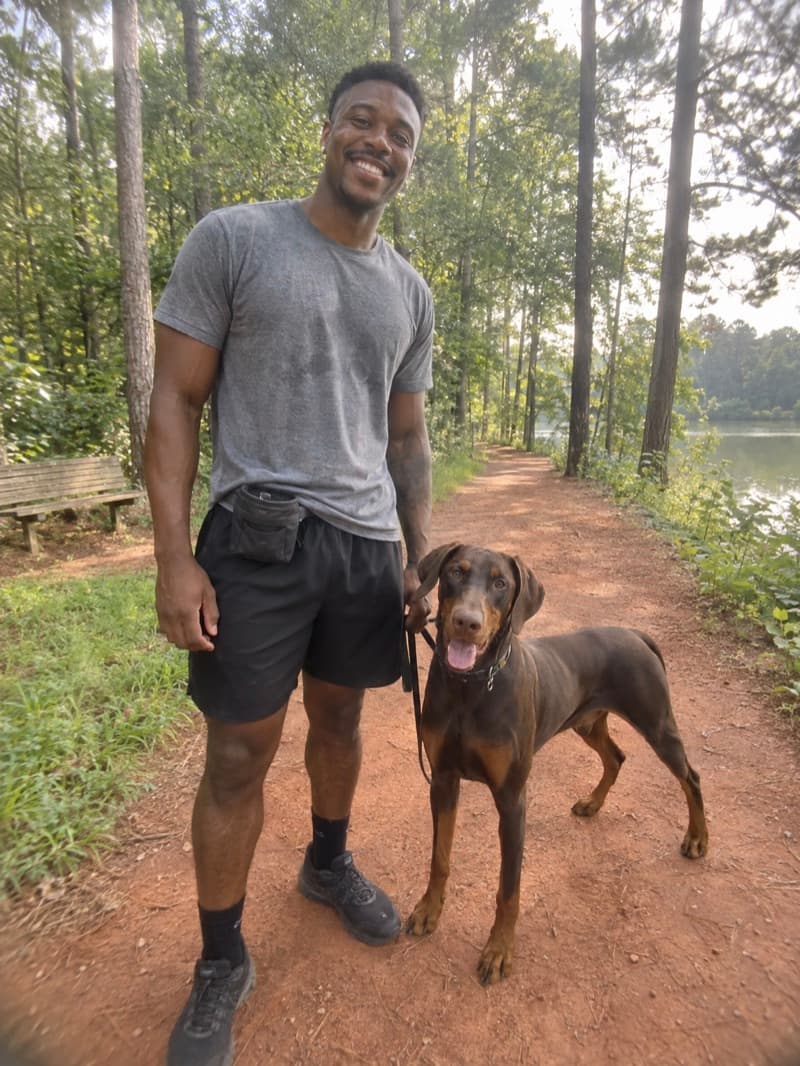
Your plan is made by Darius Jackson. Dog trainer, specializing in alone time and adolescent dogs.
 4.4 on Trustpilot. 2,966 dog owners started before you.
What separation anxiety in dogs really is
Separation anxiety is a panic response to being left alone. It isn't bad manners, and you didn't cause it by loving your dog too much. The barking, the scratching at the door and the accidents are what that panic looks like from the outside. Separation anxiety dog training works by rebuilding alone time from the very bottom: an absence so short your dog stays relaxed, repeated until it's boring, then stretched a few seconds at a time. Leaving him to cry it out usually backfires, because every panicked absence teaches him once more that being alone is frightening. Some dogs who chew or bark when left are bored rather than anxious, so a good plan starts by working out exactly when the stress begins and what it looks like.
Does this sound familiar?
You haven't been out without him in months
Groceries get delivered. Friends come to your place, because going to theirs means he's alone. You and your partner take turns at weddings and birthdays, and a dentist appointment takes planning.
A note from the neighbors
Thin apartment walls and a dog who barks or howls from the moment you leave. Someone mentions it in the hallway or the building manager emails, and now every trip out comes with a knot in your stomach.
Back to the office three days a week
For a long stretch someone was always home, and it was never an issue. Now the return-to-office date is on the calendar, and you're doing the math on how many hours he'd be alone.
You watched the pet cam once
Pacing from minute two. Whining at the door, panting, checking the window, never lying down. You closed the app and haven't been able to watch it since.
Why "he'll get used to it" usually backfires
The common advice is to keep leaving and let him get used to it. For a dog who is truly panicking, that's not how fear works. Every absence where he goes over his limit is another rehearsal of the same alarm: you leave, something terrible happens inside him, and it only stops when you walk back in. He isn't punishing you for going, and he isn't learning that alone is fine. His body is learning that alone is dangerous, a little more firmly each time.
What does work is starting below his threshold, the point where calm turns into stress. For some dogs that's 2 minutes, for others it's the sound of the door closing. You practice right under that line, with absences so short and so varied that they stop meaning anything, and you only move up when he has stayed relaxed. It starts before you even reach the door, too. Your keys, your shoes, the way you grab your bag: your dog knows that sequence better than you do, and as long as it signals panic, every session begins with a dog who is already tense. So the plan takes the meaning out of those cues first.
The part that surprises most owners is that long absences during training can undo the practice. If he's comfortable at 5 minutes and then spends a workday alone, he's back to rehearsing panic. That's why a plan also covers the hours you can't train: a dog walker at lunch, a few days of daycare, a friend or family member, or taking him along where you can. And you film every session, even with an old phone, because the first sign of stress is often a lifted head or a glance at the door that you'd never see from the other side of it.
What your first week looks like
No hour-long sessions and no class across town. A few short exercises a day, fitted around your work and your home, with each one explaining how to do it and what to watch for. This is how the start usually looks for separation anxiety. Your plan changes wherever your answers call for it.
Find the moment it starts
Set up your phone to record, leave the way you normally would, and come back after a short while. Watch the video and note the second the first sign shows up: pacing, whining, panting, waiting at the door. That number is your starting point, and it's usually lower than you expect.
Make your keys boring
Pick up your keys and put them back. Put your shoes on and sit down on the couch. Grab your bag and go make coffee. Dozens of times, without leaving, until your departure routine stops predicting anything.
Seconds on the other side of the door
Step out, close the door, come back in calmly before he reaches his limit. Mix the lengths: 5 seconds, 12, 3, 20. You move up only after two calm reps in a row, and you drop back the moment one isn't.
Calm returns and a cover plan
Come back in quietly and skip the big hello, so your return isn't a jackpot either. Then line up help for the days you have to be gone longer, so one long afternoon doesn't erase a week of small wins.
Someone to ask when a session goes sideways
Your coach reads your answers about your dog, your home and your schedule, and makes the plan around them. When a session goes wrong, or you can't tell whether that whine at minute three means stop, you describe it and ask. Your coach answers and adjusts the next step, so you aren't left guessing on your own.
Darius Jackson · Dog trainer, specializing in alone time and adolescent dogs
Guides owners of dogs who can't be left alone, and of teenagers who seem to forget everything they once knew. Darius co-developed the structure and settle-down steps in DoggoPlan, and builds the plans for alone time, so your dog learns step by step that you always come back.
Owners who couldn't leave the house either

The plan built it up minute by minute, exactly around what I'd filled in. Now he stays calm in his bed when I run errands.

The coach who built the plan gave a build-up that actually fit his age. Within two weeks he slept through. What a difference for the whole house.

After a few weeks she's noticeably calmer, though the doorbell is still a thing. For the price I didn't expect this. Only downside: I'd have liked a few more videos.
What owners ask us about separation anxiety
Is it separation anxiety, or is he just bored?
Will a crate or a second dog solve it?
How long does separation anxiety dog training take?
What do I do on days I have to leave him for hours?
When should I see a vet first?
I work full time. Can this still work for us?
This is training guidance, not veterinary advice. If behavior changes suddenly, or your dog growls or snaps, always involve your vet or a qualified behavior professional.
If it doesn't work for you, you get your money back
You have 60 days. No small print, no form, nothing to prove. Just email us and we refund every cent.
$59 one-time, no subscription, 60-day money-back guarantee with no conditions.
Read more about separation anxiety
Working on something else?
- Dog lunges or barks on walks
- Dog is scared of almost everything
- Dog is scared of fireworks and thunder
- Trainer, behaviorist or an online plan?