A good separation anxiety training schedule is set by your dog, not the calendar: you train about five days a week, keep every absence shorter than the time it takes your dog to get upset, and only add time after calm repetitions. For most dogs that means starting with seconds or a few minutes and working up over several months, so the schedule below shows a realistic pace and how to slow down when you need to.
If you've found a plan online that promises six hours alone in six weeks, and it fell apart in week two, that's because those plans move on a fixed timetable, while your dog's progress depends on how he feels at each step.
Before you start: three ground rules
Rule out pain or illness. The ASPCA advises you to "rule out medical issues" first, and the RSPCA notes that "Underlying health issues can cause or contribute to the development or worsening" of separation-related behavior. Accidents in the house or a sudden change in an older dog are good reasons to see your vet.
Stop the long absences for now. The ASPCA is clear that during training, "your dog cannot be left alone except during your desensitization sessions." Every time he panics alone, he practices panicking. This is the hardest part for most people, so plan it before you start: a dog sitter two mornings a week, a neighbor who works from home, daycare, or taking him with you when you can.
Get a camera. You need to see what he does when you leave, not guess from the state of the door. The RSPCA suggests "installing a camera to monitor your pet while you're out." Any cheap home camera on your phone will do. It also matters because, according to the RSPCA, "8 out of 10 dogs find it hard to cope when left alone. Yet, half won't show any obvious signs."
Find your starting point
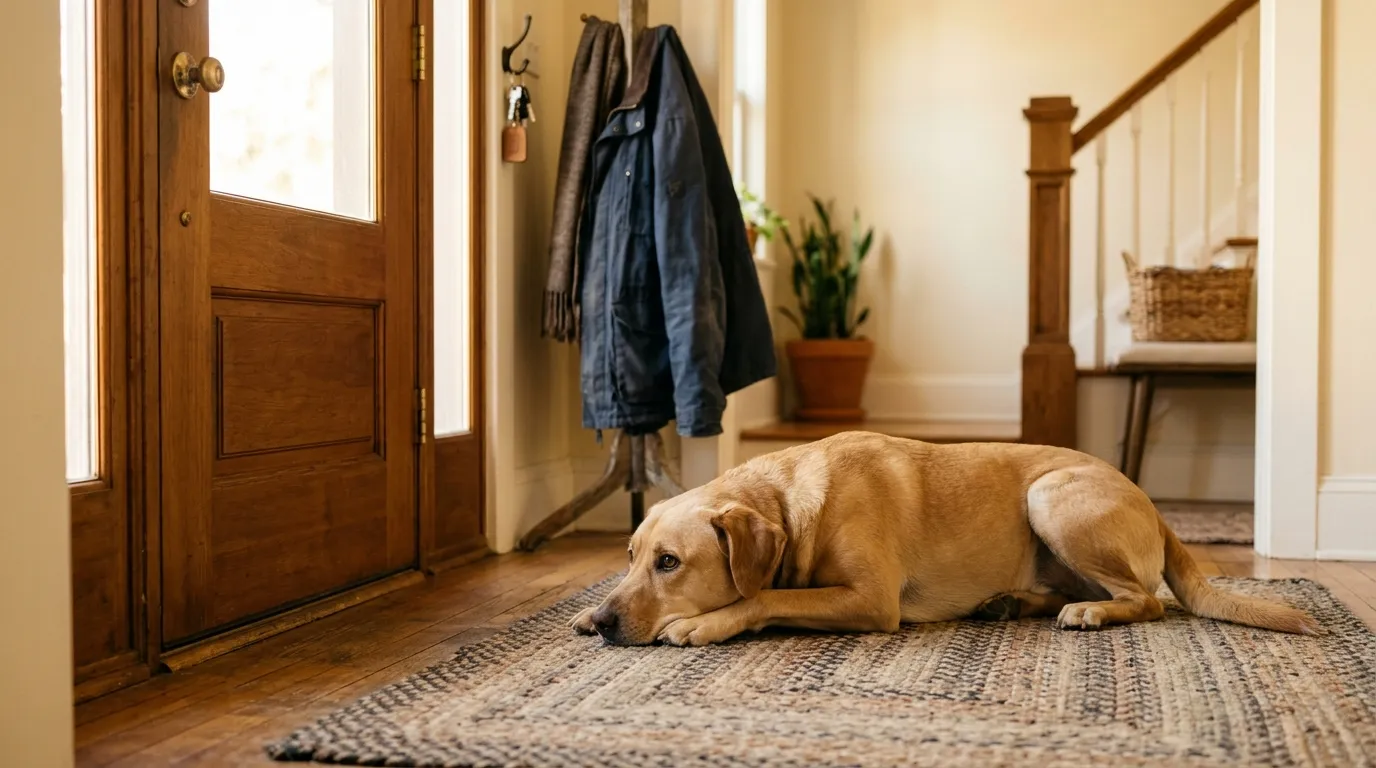
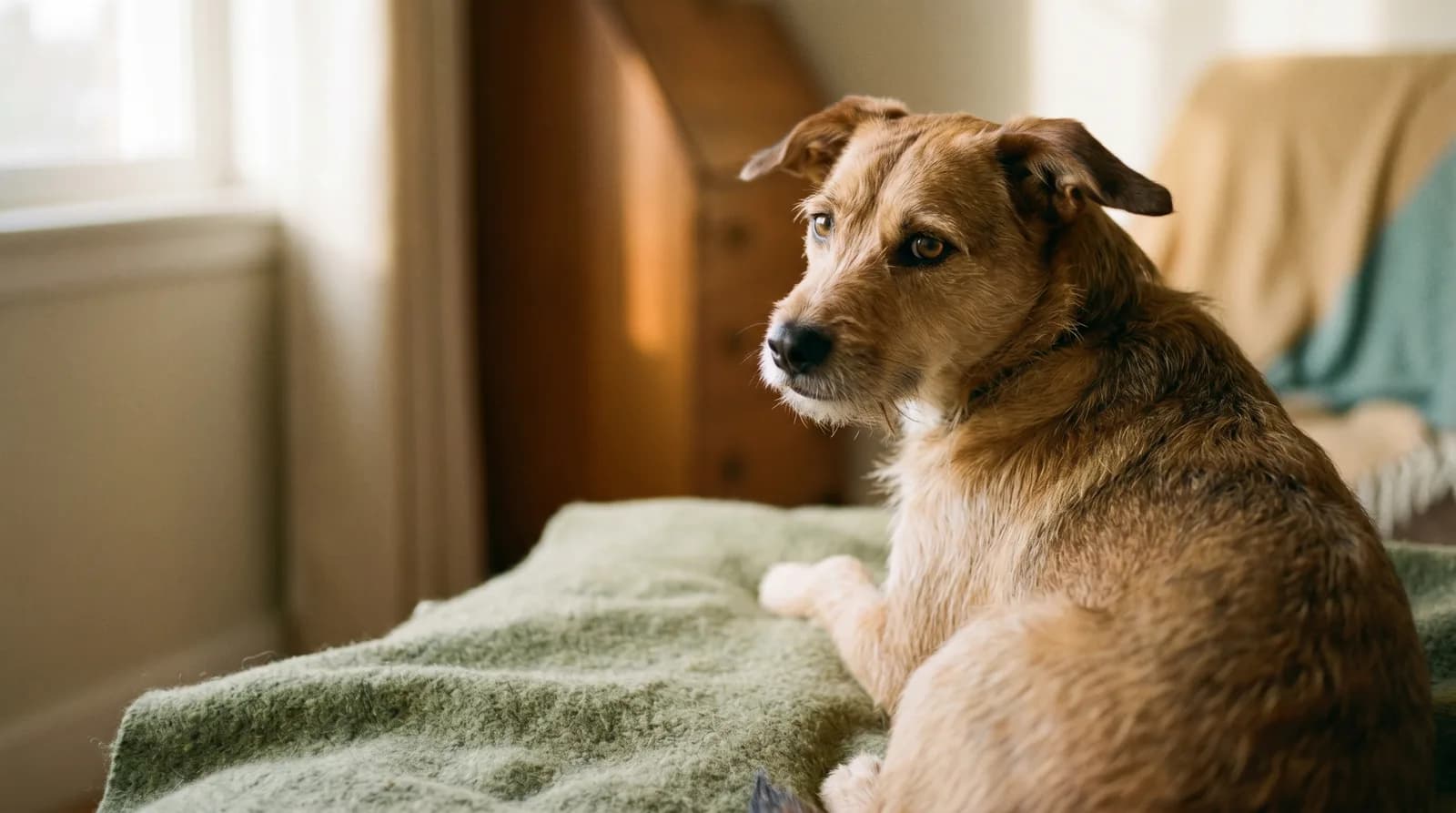
Step out the front door, start a timer, and watch on your phone. Come back in before he gets upset, or the moment you see the first sign of stress. That first sign is your dog's current limit. Signs the ASPCA tells you to watch for during absences include "dilated pupils, panting, yawning, salivating, trembling, pacing and exuberant greeting." Whining, barking at the door, scratching and lying stiffly by the door are common too.
Your first training absences sit well below that limit. The ASPCA puts it simply: "plan your absences to be shorter than the time it takes for your dog to become upset."
The separation anxiety training schedule, week by week
Here's what a realistic first few months can look like. It's based on a typical case: a 2-year-old rescue who starts pacing and whining about 2 minutes after the door closes. Your dog's numbers will be different, so use the shape of it, not the exact times.
| Week | Longest absence | What you're working on |
|---|---|---|
| 1 | 30 seconds to 1 minute | Picking up keys, putting on shoes and touching the door handle without leaving. Short exits of a few seconds. |
| 2 | 1 to 2 minutes | Walking out and closing the door. Lots of very short exits mixed in. |
| 3 to 4 | 2 to 5 minutes | Locking the door, walking to the car or the end of the hall |
| 5 to 8 | 5 to 15 minutes | Starting the car, getting the mail, a lap of the block |
| 9 to 12 | 15 to 30 minutes | Coffee down the street, a quick errand |
| 13 to 16 | 30 to 45 minutes | Getting past the first 40 minutes, where most of the worry happens |
| After that | Larger steps toward 90 minutes, then longer | Real-life absences, one at a time |
The slow start follows the ASPCA's guidance. It says "most of your dog's anxious responses will occur within the first 40 minutes that he's alone," and recommends increasing departures "by only a few seconds each session, or every couple of sessions." Once a dog is reliably calm past 40 minutes, the ASPCA suggests bigger jumps, "5-minute increments at first, then later 15-minute increments," up to 90 minutes. That's why many dogs crawl through the first months and then speed up.
The ASPCA also says "there are no standard timelines." Some dogs move faster than the table above. Some need twice as long. Both are normal.
What a training day looks like
Keep it short. A session of 10 to 20 minutes, once a day, is plenty.
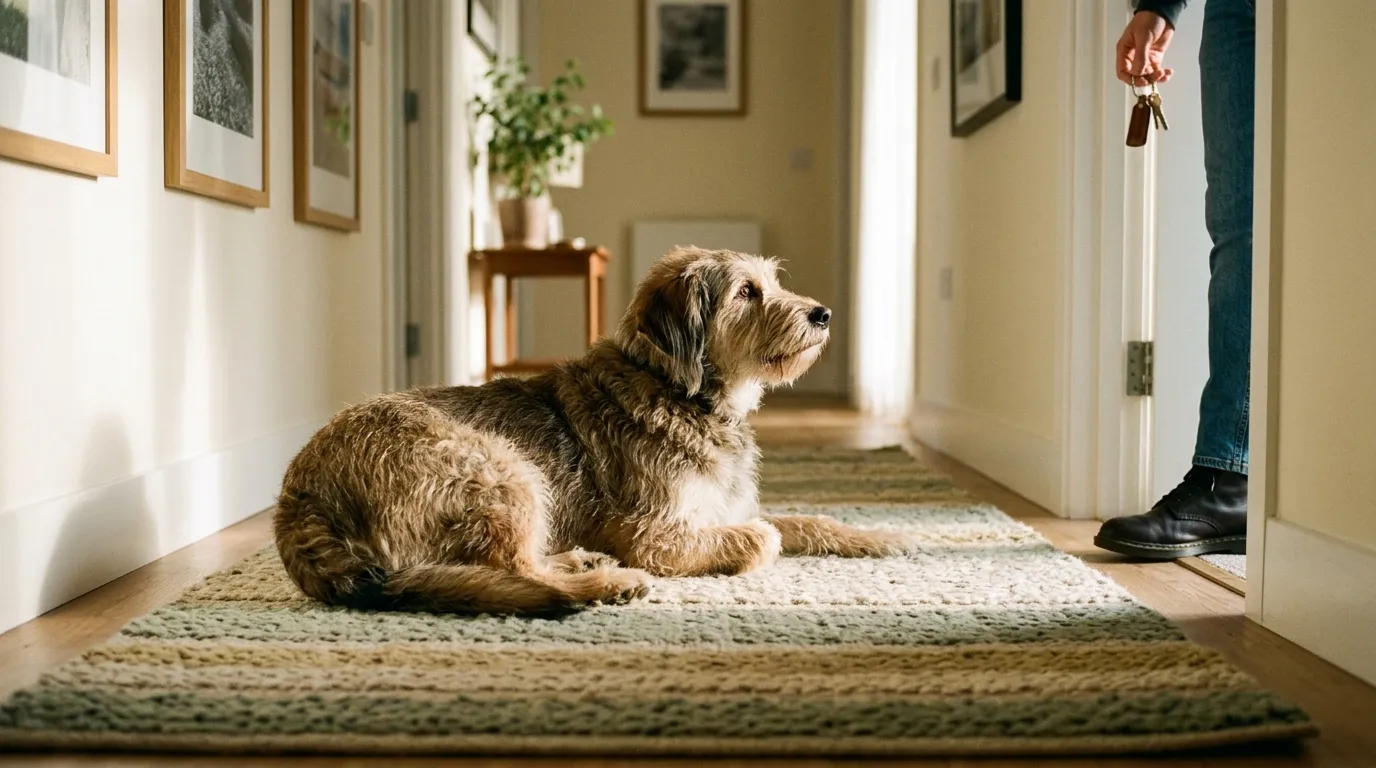
- Warm up with a few departure cues. Pick up the keys, put them down. Put your coat on, take it off. VCA Animal Hospitals suggests that "Only 3 to 4 repetitions should be done in a day," so don't overdo it.
- Do 3 to 5 absences of mixed length. Not every one longer than the last. If today's target is 4 minutes, you might do 1 minute, 3 minutes, 30 seconds, 4 minutes, 2 minutes. VCA's advice is to "Gradually but randomly increase the time."
- Come back in calmly. No big hello. Sit down, carry on with your day.
- Write it down (log below).
Then take days off. Separation anxiety trainer Malena DeMartini writes that "We work together five days a week on separation anxiety training," and that "There are genuine benefits to the learning process when we allow for days off." A rest day doesn't mean leaving him alone. It just means no practice.
Your daily log
Copy this into a notebook or a notes app. After a couple of weeks you'll see patterns you'd never spot from memory, like the dog who is fine on weekdays and wobbly on Saturdays when the neighbors are home.
| Date | Planned longest absence | What you did | First stress sign (time and what) | Calm? | Next session |
|---|---|---|---|---|---|
| Mon | 3:00 | 1:00, 2:30, 0:30, 3:00 | none | Yes | Try 3:30 |
| Tue | 3:30 | 1:30, 3:30, 0:45 | Whined at 3:10 | No | Back to 2:30 |
| Wed | Rest day | ||||
| Thu | 2:30 | 1:00, 2:30, 2:00, 0:30 | none | Yes | Repeat 2:30 |
When to step back
Stepping back is part of the method: each wobble shows you where his edge is today. Simple rules that work for most dogs:
- One stress sign in a session: next session, go back to the last time that was fully calm.
- Two shaky sessions in a row: go back about a week in the schedule and rebuild from there.
- A bad real-life absence (the sitter canceled, you got stuck at work): expect a dip. Drop back a step or two for a few days.
- No progress for three or four weeks: something in the setup needs to change, and it's a good time to bring in help.
What not to do
- Don't punish. The ASPCA warns that if you scold or punish, "the problem could get much worse." Coming home to a chewed door is awful, but he did it in a panic.
- Don't use the crate to get through absences. Dogs Trust says "Crate training alone won't stop your dog worrying about being left," and warns of "a serious risk of injury if a dog panics when left alone in a crate."
- Don't wait for quiet before you come back in. If he's barking, you've already gone past his limit. Come in calmly and make the next absence shorter.
Does gradual absence training actually work?
The evidence is small but encouraging. In a study of eight dogs published in Applied Animal Behaviour Science, researchers at the University of Waikato found that six dogs followed up three months after training "showed almost complete elimination of the problem behaviour," and concluded that "systematic desensitization was the critical element." That's the same slow, below-the-limit approach as the schedule above.
When to get help
If you're stuck after a month, or your dog is hurting himself trying to get out, please bring in help. Our guide to separation anxiety trainer cost explains what a specialist charges, and how to calm an anxious dog covers the calm, predictable routine that makes this training easier. If you're not sure your dog's behavior is about being alone at all, the signs of anxiety in dogs guide can help you tell.
If you'd like a schedule like this set up around your dog's starting point and your week, you can take the free quiz and see how the plan works for separation anxiety. Your coach makes the plan with you, step by step.
This is training guidance, not veterinary or medical advice. If your dog injures himself when left, or the problem started suddenly, please talk to your vet.