He hides when anyone visits and freezes at the end of the driveway
The doorbell rings and he is behind the couch, or barking in the hallway at a friend he has met ten times. Outside he plants his feet before you reach the sidewalk. That is not stubbornness or a bad start. It is fear, and fear can be trained in small, safe steps. Your coach makes you a 30-day plan that starts from what your dog can handle today.
Your plan is made by Hannah Kowalski. Dog behavior consultant, specializing in fearful, sensitive, and senior dogs.
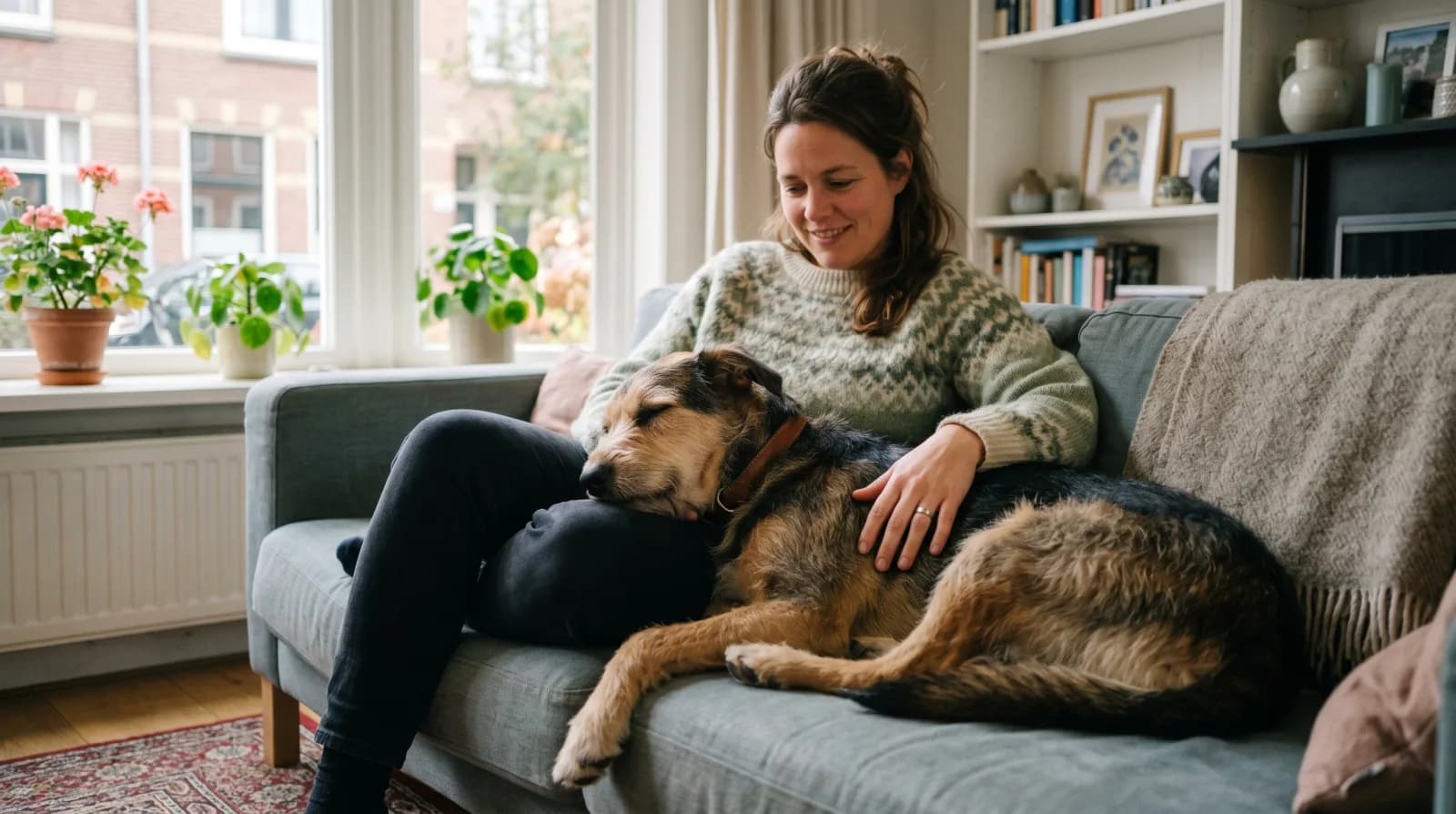
 4.4 on Trustpilot. 2,966 dog owners started before you.
What fearful dog training actually is
Fearful dog training is not about getting your dog used to scary things by giving him more of them. It works the other way around. First he needs to feel safe at home: a spot nobody disturbs, a day that runs the same way, and the freedom to move away from what worries him. Only then do you work on one trigger at a time, the doorbell, a visitor, the corner of your street, at a level he notices but can still handle, and you follow every sighting or sound with something he loves. Over many short repetitions the trigger starts to mean food and calm instead of danger. Progress comes from distance and choice, not from pushing through. A scared dog who learns he can always step back has much less reason to bark, freeze or hide.
Does this sound like your dog?
Visitors mean he disappears, or barks the whole time
He spends the evening upstairs under the bed, or he stands in the hallway barking at your sister, who has been over twenty times. You have started meeting friends at a coffee shop instead of at home.
The walk is over before it starts
Leash on, door open, and he locks up on the porch. Or he makes it fifty yards, then pulls hard for home at the first truck or jogger. Some days you just let him stay in the yard.
The house itself is full of scary sounds
The dishwasher beeping, the ice maker, a pan hitting the floor, the garbage truck every Tuesday. Instead of sleeping, he spends the evening watching the hallway with his ears pinned back.
With you he is a completely different dog
On the couch he is soft, goofy and silly with his toys. That is what makes it hard when other people only ever meet the frozen, trembling version and decide he is unfriendly.
Why "he just has to get used to it" backfires
The most common advice for a scared dog is still to take him everywhere, let everyone pet him and keep the visitors coming until he gets over it. Trainers call that flooding: the full trigger, up close, with no way out. Sometimes the dog goes quiet and it looks like it worked. Often what you are seeing is a dog who has shut down, not one who has relaxed. He learns that the scary thing can corner him, so the next time he is on alert sooner and reacts harder.
That is why a good plan for a fearful dog starts with safety and choice, before any training. Decompression comes first: a few days with fewer demands, one safe spot that is always his, and meals, potty breaks and rest at the same times. Small predictable routines tell him what happens next, and a dog who can predict his day has less to scan for. Choice matters just as much. Visitors ignore him, nobody pulls him out from under the table, and he decides when to come closer. A dog who knows he can leave does not have to defend himself.
Then comes counter-conditioning, one specific trigger at a time. The doorbell played quietly from your phone in another room. A guest sitting at the far end of the couch. The corner of your street, seen from your front step. Each time he notices it, something great follows, like a piece of chicken or a handful of food on the floor. Repeated often and kept small, the trigger starts to predict good things. The order matters: a dog who does not yet feel safe at home cannot learn much on a busy sidewalk. And if he growls or snaps at visitors, treat that as a warning to respect, not a problem to train away on your own. Keep him and your guests apart for now and get a qualified behavior professional involved.
What your first seven days look like
No group class to drive to and no throwing him in at the deep end. A few short exercises a day, built around the week you already have. This is how a plan for a fearful dog usually starts. Yours changes wherever your answers call for it.
A safe spot and a list
You set up one place that is only his, like a crate with a blanket over it or a bed behind the couch, and nobody reaches in. Then you write down what scares him and how close is too close. That list sets the order of the plan.
Same rhythm, fewer surprises
Meals, yard breaks and quiet time happen at the same times each day. Before anything new, he hears the same short phrase and gets a treat. If walks shrink to the yard for now, that is part of the plan, not a step back.
One sound, very quietly
You pick one trigger, often the doorbell. You play it from your phone in another room, so quietly he barely looks up, and food lands right after. Five repetitions and you stop. If he stops eating or leaves, it was too loud, so you go quieter next time.
A visitor who ignores him
One calm friend sits down, with no eye contact and no reaching. Each time your dog looks at them, you toss a treat away from the visitor, so he can come closer or stay back. He chooses. The visit ends before he gets tired.
Someone to ask when a day goes sideways
Your coach makes your plan around your answers: where he hides, which sounds set him off, who comes to the house and what your week looks like. When a visit goes badly, or he refuses to leave his spot for a whole day, you describe what happened and ask your coach. You get the next step for your dog, in your house, not a general tip.
Hannah Kowalski · Dog behavior consultant, specializing in fearful, sensitive, and senior dogs
Works with dogs who startle easily: at fireworks, storms, new places, or a new home. Hannah shaped the calm routines and gentle pacing in DoggoPlan, and builds the plans for fearful and newly adopted dogs, so every exercise stays within their limits and never moves too fast.
Owners whose dog used to hide from everything

The plan took her past into account instead of being a one-size course. She now dares to sit next to me on the bench and even lets the kids approach. Small steps, big difference.

The plan built it up minute by minute, exactly around what I'd filled in. Now he stays calm in his bed when I run errands.

The exercises are short and playful, which works far better with a pup than being strict. He now comes back nine times out of ten when I call.
What owners of fearful dogs ask us
Is he scared because he is a rescue?
Should I make him meet people so he gets used to them?
He growls or snaps at visitors. Can you help with that?
How long until he is more relaxed?
What if he's so scared he won't even take a treat?
Is it a subscription?
This is training guidance, not veterinary advice. If behavior changes suddenly, or your dog growls or snaps, always involve your vet or a qualified behavior professional.
If it doesn't work for you, you get your money back
You have 60 days. No small print, no form, nothing to prove. Just email us and we refund every cent.
$59 one-time, no subscription, 60-day money-back guarantee with no conditions.
Read more about fearful and anxious dogs
Working on something else?
- Dog lunges or barks on walks
- Dog can't be left alone
- Dog is scared of fireworks and thunder
- Trainer, behaviorist or an online plan?