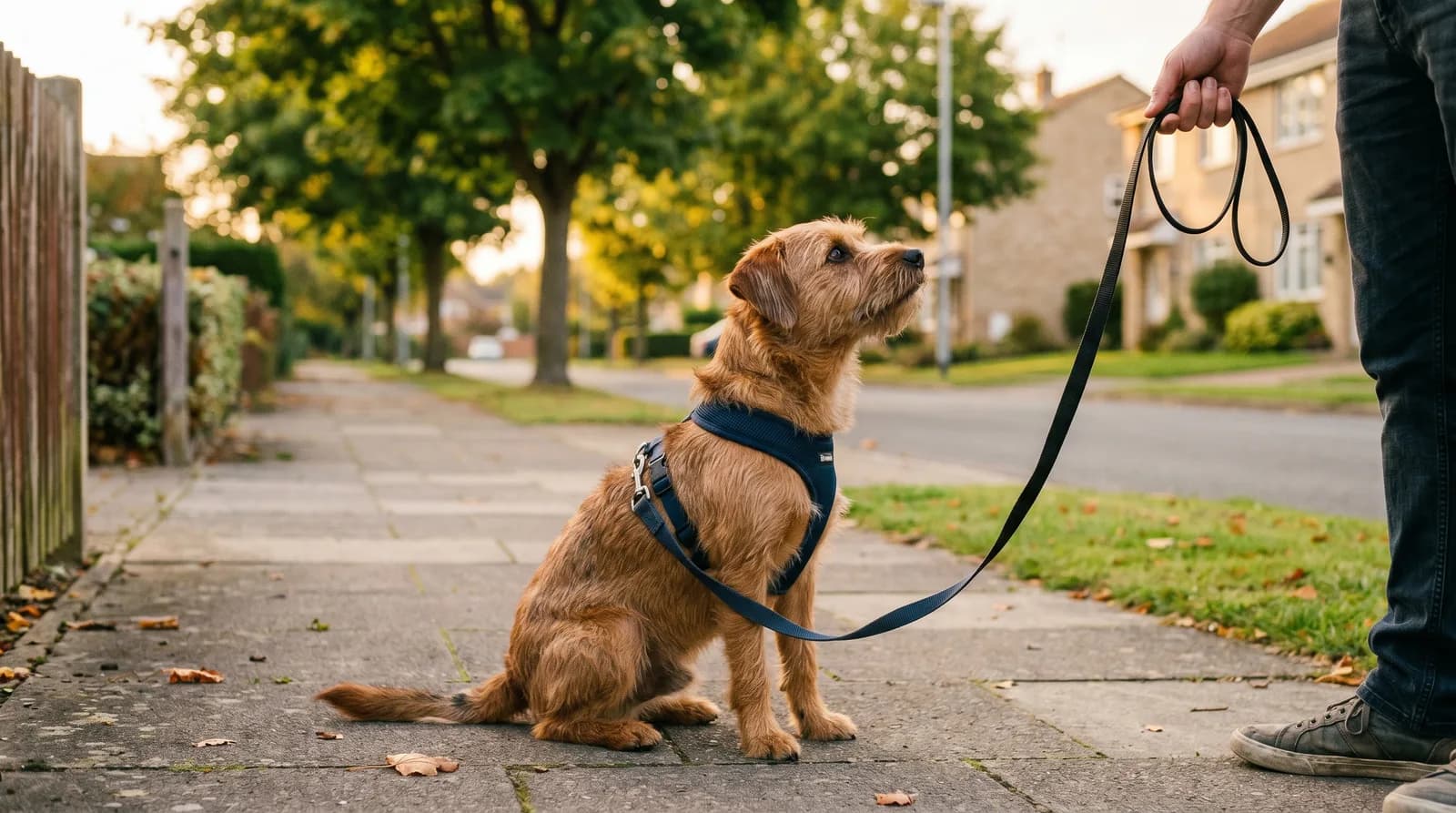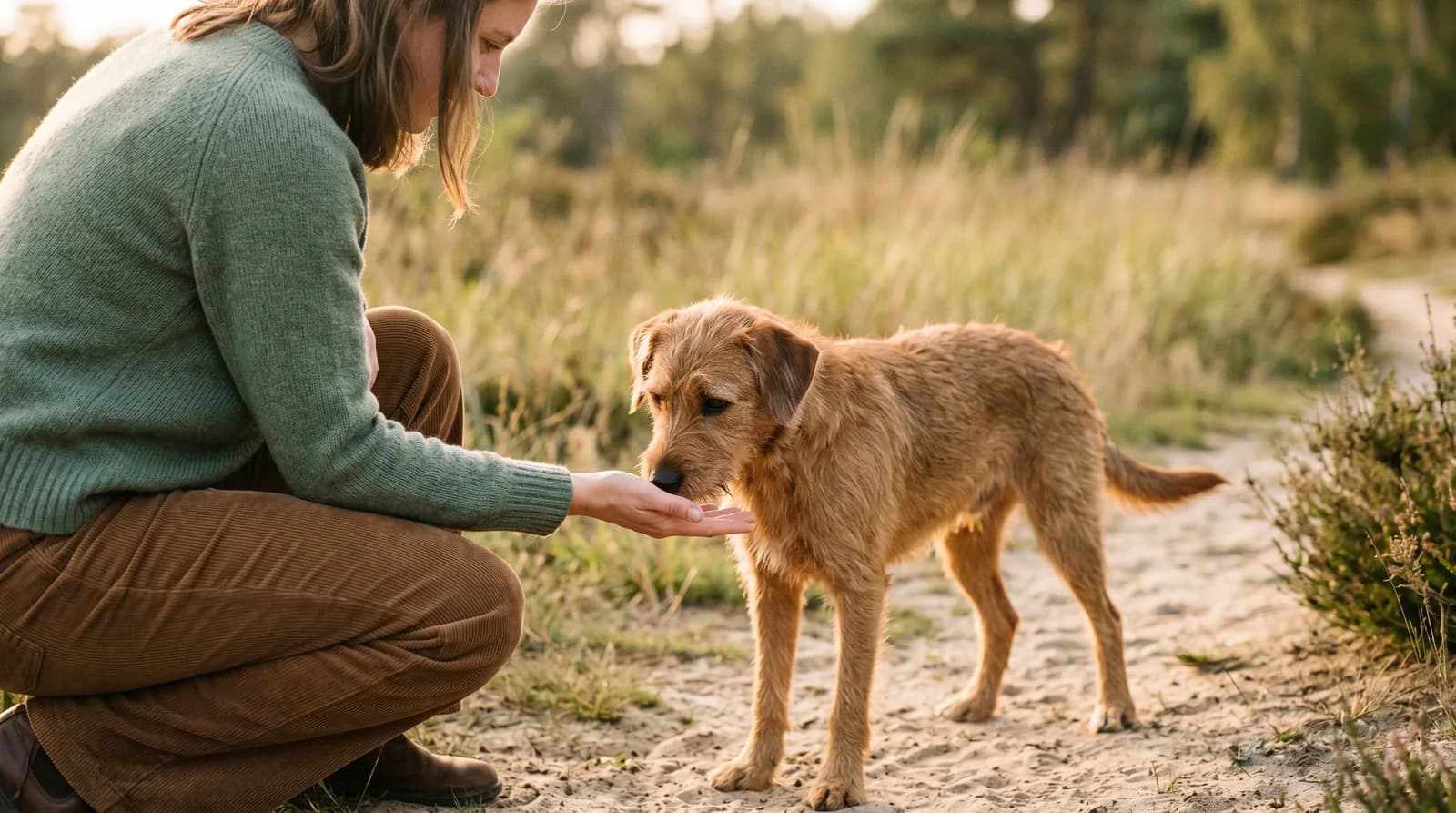
If your dog lunges at the end of the leash, ignores you when he's wound up, or guards his bed, someone has probably told you he's "being dominant" or "trying to be the alpha." Maybe a stranger at the park. Maybe a trainer. Maybe a small voice in your own head at 7am, dreading the walk. Here's the thing worth knowing before you read another word: the dominance myth is one of the most damaging ideas in dog training, and it is very likely sending you in exactly the wrong direction with a dog who is not stubborn at all. He's scared. And that's fixable.
What the dominance myth actually says
The story goes like this. Dogs are pack animals, the pack runs on a strict hierarchy, and your dog is constantly angling to climb it. So when he pulls on the leash, barks at other dogs, won't lie down when told, or stiffens over his food, he's "asserting dominance." The fix, supposedly, is to out-tough him: be the alpha, win every standoff, never let him "get away with it."
It's a tidy story. It even feels true, because it gives you something to push against. The only problem is that it isn't real.
Why the alpha dog idea fell apart
The whole alpha-wolf model came from studies of unrelated captive wolves crammed together in the mid-1900s, animals under enormous stress, behaving nothing like they would in the wild. When researchers later watched real wolves, they found something completely different: cooperative family groups, more like parents and their growing pups than rivals in a cage match. The scientist whose early work popularised the word "alpha" has spent years since asking people to stop using it. It does not describe wolves, and it certainly doesn't describe the dog asleep on your sofa.
Domestic dogs are not wolves anyway. They've spent thousands of years evolving alongside us, reading us, leaning on us. Your dog is not running a quiet campaign to overthrow you. He doesn't think in ranks. He's just trying to feel safe in a world that often feels too big and too loud.
What "dominant" behaviour usually is
Look closely at the behaviours that get called dominant, and a different picture comes into focus almost every time.
- Pulling like a freight train is usually a dog who's overstimulated, anxious about what's ahead, or simply never taught that walking near you pays off. Not a power grab.
- Barking and lunging at other dogs is fear wearing a loud coat. A dog who feels cornered makes himself big and noisy to push the scary thing away. We unpack this fully in reactive dog training.
- Guarding a bone, a bed, or a spot on the couch is a dog who's worried about losing something that matters, not staking a claim to the throne.
- "Not listening" is almost always a dog who is too stressed to hear you, or who genuinely doesn't understand what you want yet. A flooded brain can't follow cues.
- Standing his ground, freezing, or growling is fear hitting its ceiling. That growl isn't defiance, it's a warning he'd rather not have to give.
None of that is a dog being bossy. It's a dog being overwhelmed and doing the only thing that makes the bad feeling stop. As we put it in your dog isn't naughty, he's scared: bad behaviour is usually a dog who feels bad.
Why the dominance myth makes everything worse
This is where the dominance myth stops being a harmless misunderstanding and starts actively hurting the dog you love.
If you believe your dog is challenging you, the "logical" response is to push back: leash jerks, alpha rolls, pinning him down, staring him out, telling him off when he reacts. And here's the cruel part. To a dog who was already frightened, all of that confirms his worst fear, that the world, and now you too, is unpredictable and unsafe.
You might shut the behaviour down for a moment. But you haven't changed how he feels, you've only taught him to hide it, or to skip the warning growl and go straight to a snap next time. You cannot punish a feeling away. Fear plus more fear never adds up to calm.
The fear lens leads somewhere completely different. Once you see a scared dog instead of a defiant one, the whole job changes. You stop trying to win, and you start trying to help. You add distance from the scary thing. You drop the volume. You reward him for feeling calm instead of correcting him for feeling afraid. That softer approach isn't going easy on him, it's the thing that genuinely works, and it's the heart of how to calm an anxious dog.
"But my dog really is stubborn"
You'd be amazed how often "stubborn" is just "scared" in a costume.
The dog who plants his feet and won't move past the corner where the big dog lives isn't being difficult, he's telling you, as clearly as he can, that he can't cope there yet. The dog who "knows" the cue at home but "refuses" it on a busy street isn't disobeying, he's too far over his threshold to think. The dog who suddenly "won't" do the thing he did yesterday is usually a dog whose stress tank filled up faster today.
When you trade the word "stubborn" for the question "what's he afraid of right now," the answer almost always appears, and with it, something you can actually do.
What to do instead
You don't need to dominate anything. You need to make your dog feel safe enough to think.
- Notice what he's reacting to, not just what he's doing. The trigger is the real story.
- Give him room. Distance from the scary thing is the fastest way to bring him back under threshold.
- Reward calm. Catch the quiet moments and pay for them generously with food he loves.
- Drop the standoffs. There's no battle to win here, only a frightened dog to reassure.
Your dog was never trying to beat you. He was trying not to drown. Once you stop fighting him and start helping him, you'll often find the "dominant" dog and the sweet, soft dog underneath were the same dog all along, just waiting to feel safe enough to show up.
If your dog's fear is severe or comes on suddenly, or if there's any growling, snapping, or bite risk, please loop in your vet or a qualified force-free behaviour professional who can guide you safely. This is training guidance, not veterinary or medical advice.