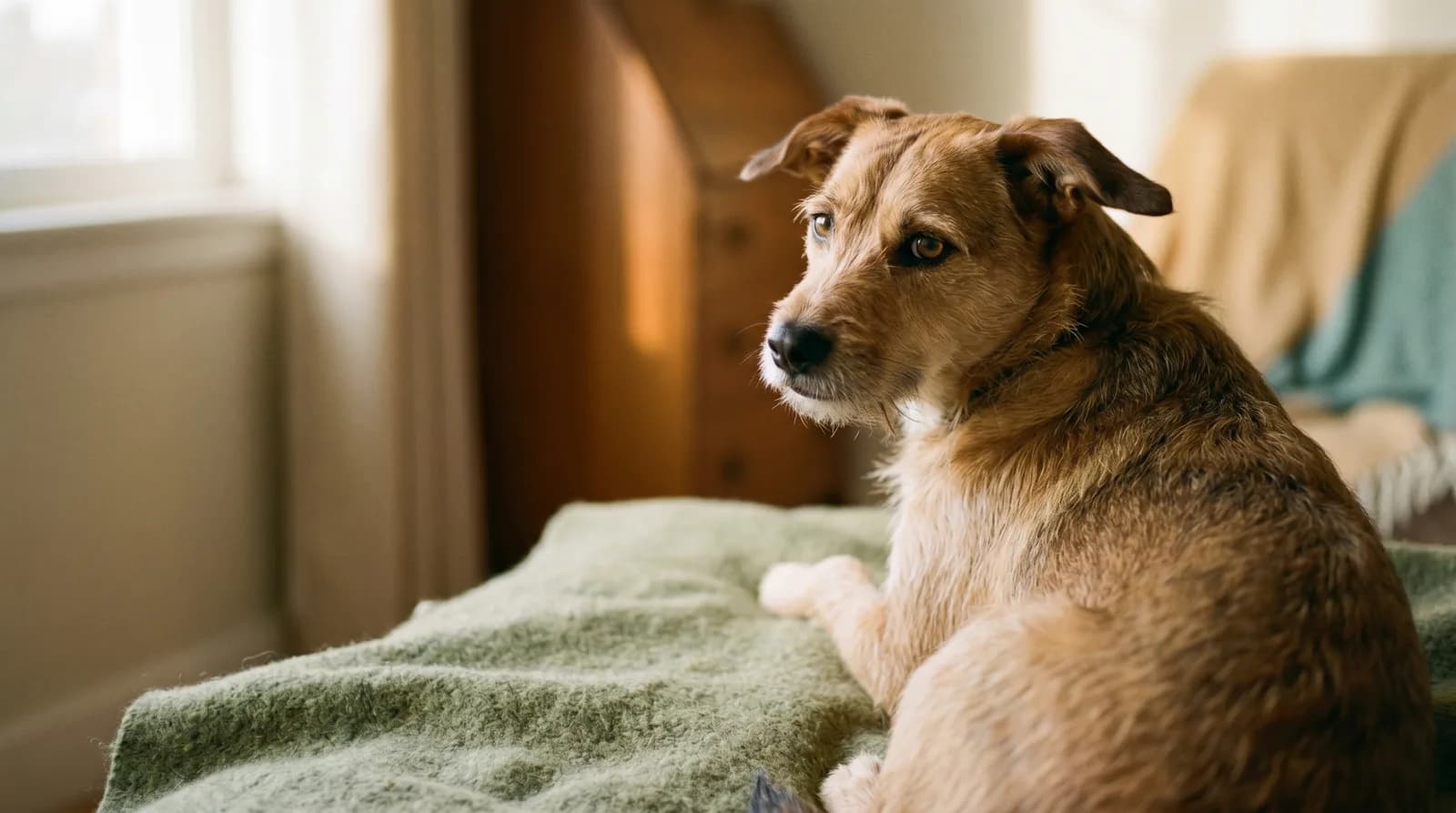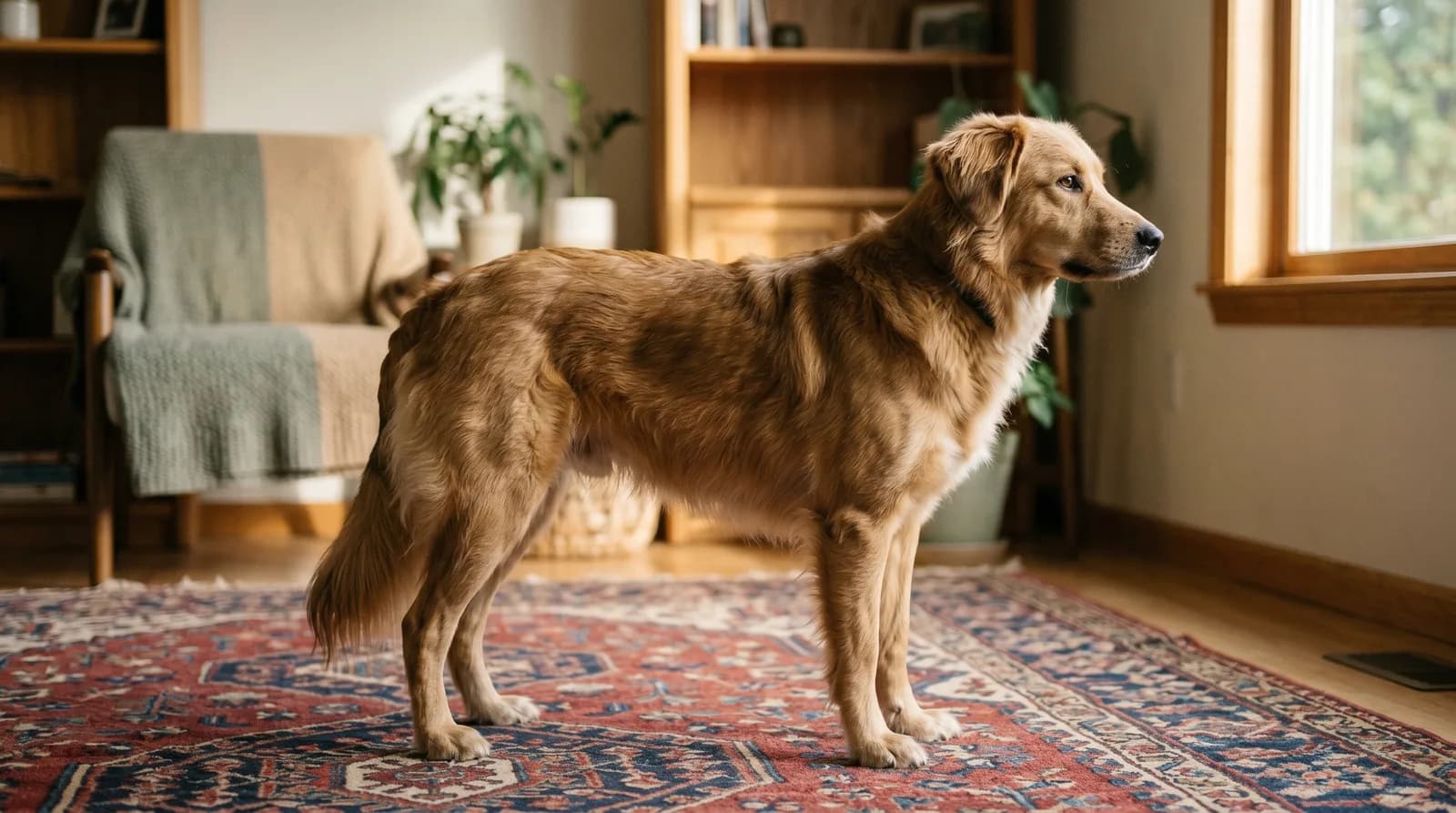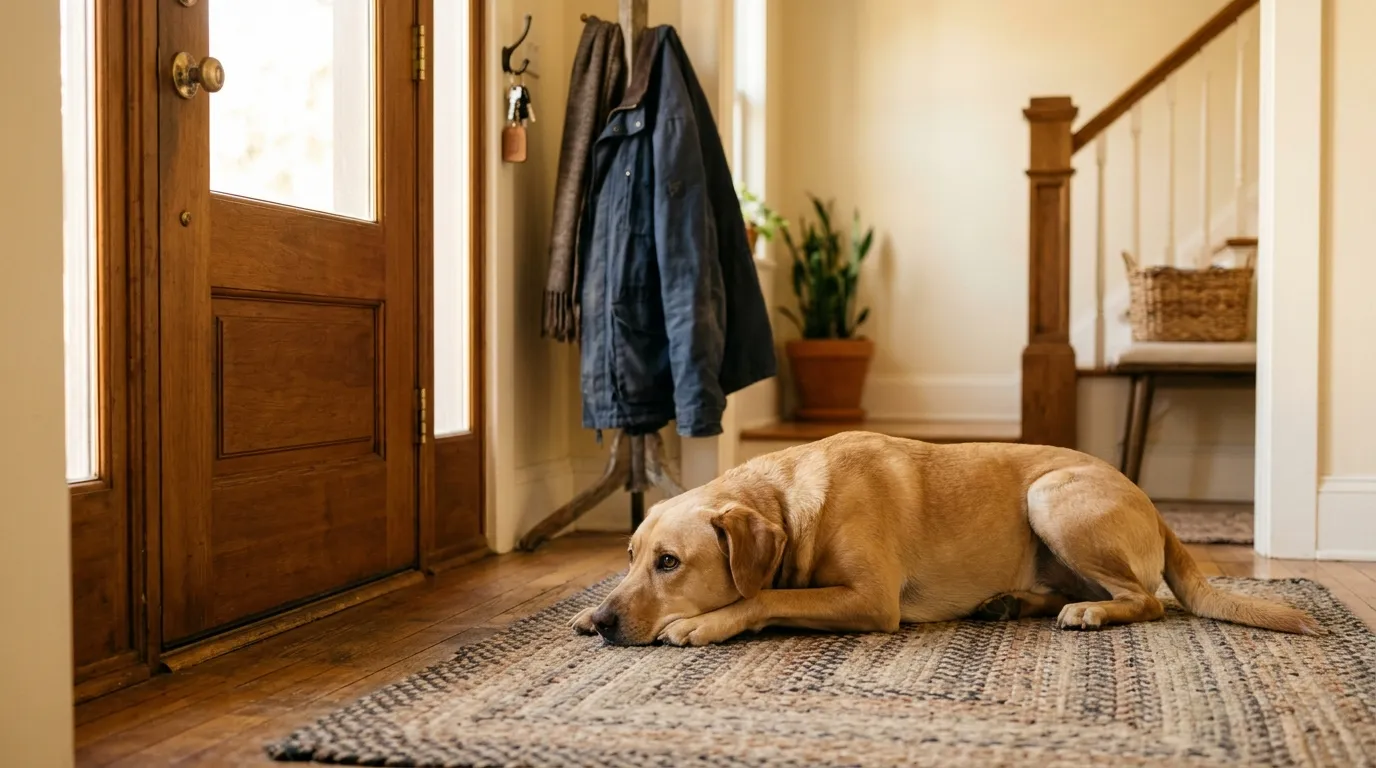
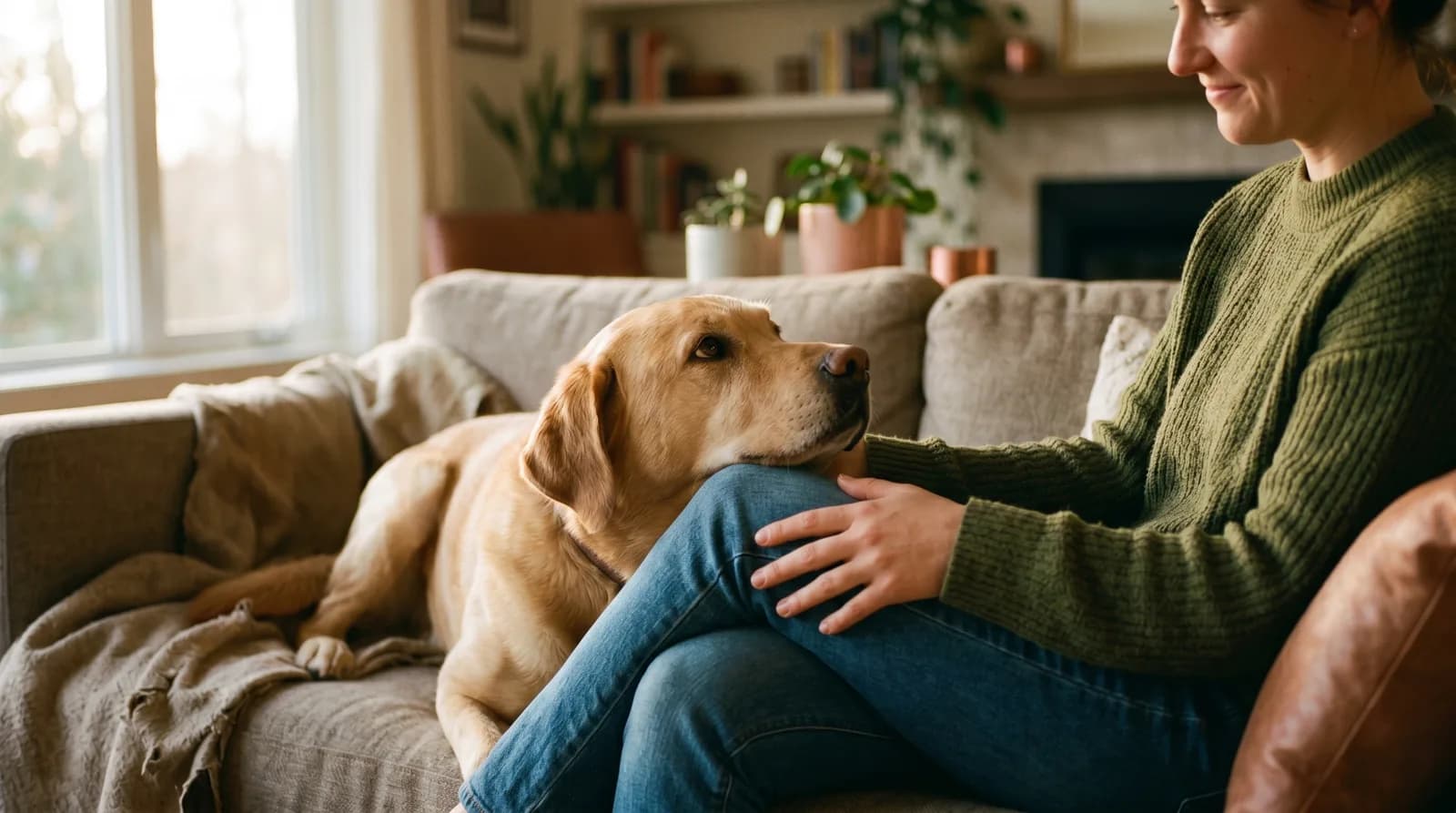
If you live with a dog who is jumpy, clingy, or just can't seem to switch off, you already know how much it can pull at you. He flinches at sounds, shadows you from room to room, won't settle even when the house is quiet, and sometimes barks or paces at things that look harmless to you. It is exhausting, and it is easy to start wondering what you are doing wrong. Here is the kinder truth, and the starting point for how to calm an anxious dog: your dog isn't being naughty, he's scared, and that is something you can change. This guide walks you through what anxiety actually looks like, the shapes it takes, why a calm force-free approach works, and where to begin.
What anxiety actually looks like in a dog
Anxiety in dogs is rarely one dramatic thing. It usually shows up as a cluster of smaller signals that, once you learn to read them, are hard to unsee.
Some anxious dogs go quiet and small: they hide, tremble, tuck the tail, flatten the ears, lick their lips, yawn when they are not tired, or refuse food they normally love. Others get louder and busier: they bark, pace, can't sit still, cling to you, or seem permanently wound up. Both are the same underlying thing, a dog who feels unsafe and is trying to cope.
A few common signs at a glance:
- Panting when it isn't hot and he hasn't been running.
- Pacing or restlessness, an inability to settle even somewhere safe.
- Lip licks, yawns, and a tucked tail when nothing tiring is happening.
- Clinginess or shadowing, following you from room to room.
- Hiding, freezing, or shutting down, going very still and switched off.
- Barking, lunging, or seeming hyper in situations that feel threatening to him.
The important thing is to notice the pattern over time, not to label a single moment. If you want to go deeper, our companion guides break this right down: read the signs of anxiety in dogs for the full checklist, and learn to read his body language so you can spot worry early, before it tips into a meltdown.
The earlier you can read "he's getting uncomfortable," the easier everything else becomes, because you can help him before he is too far gone to think.
The shapes anxiety takes
The feeling underneath is the same, but it tends to point at different things in different dogs. Knowing which shape you are dealing with helps you choose where to focus.
Noise fear. Some dogs are noise-sensitive: fireworks, thunder, the vacuum, a garbage truck, the smoke alarm, a dropped pan. The sound floods them with stress and they struggle to recover. This is so common, and so specific in how you help, that it has its own home: see dog noise phobia, fireworks, and thunderstorms.
Separation worry. Some dogs come apart when left alone: pacing, vocalising, destruction near doors, or refusing to settle until you are back. This one needs a gentle, gradual approach all of its own, and we cover it in a dedicated guide on separation anxiety.
Fear of people or strangers. A dog who shrinks from visitors, barks at people on walks, or won't take food from a new hand is usually not "unfriendly." He is unsure, and he needs distance and time, not pressure to say hello.
Reactivity on the leash. When the worry comes out as barking and lunging at other dogs or people, that is often fear wearing a loud coat. The work there is its own thing: see reactive dog training.
General fearfulness. And then there is the dog who seems wary of almost everything, new places, new objects, sudden movement, change of any kind. The "scared of everything" dog can feel overwhelming to live with, but the same calm principles below apply, just spread across more of his world.
Most anxious dogs are a blend of these. You do not have to fix all of it at once. You pick the situation that bothers him most and start there.
Why force-free works and punishment backfires
Here is the single most important idea in this guide: you can't punish a feeling away.
If you tell off an anxious dog, jerk the leash, or use anything that startles or hurts to "snap him out of it," you might stop the behaviour for a second. But you have not changed how he feels. You have just added "and now my human is scary too" on top of whatever was already frightening him. Fear plus more fear never adds up to calm.
Force-free training goes the other way. Instead of suppressing the signals, it lowers the underlying stress so the fear has less fuel, and a calmer dog behaves more calmly all on his own. You are not managing the barking or the pacing directly. You are changing the feeling that drives it, and the behaviour you disliked tends to fade with it.
This is also why the reframe matters so much. Once you stop seeing a "stubborn" or "dominant" dog and start seeing a scared one, your whole approach softens in exactly the way that actually helps. We unpack that mindset shift in your dog isn't naughty, he's scared, and it is worth a read before you start, because it changes how you respond in the moment.
The core toolkit
You do not need special equipment or a trainer's vocabulary to start helping. A handful of ideas do most of the heavy lifting.
Safety and a predictable routine
Anxious dogs relax when the world becomes predictable. Give him a quiet, cosy spot that is always his to retreat to, a covered crate, a bed in a calm corner, somewhere he already chooses to go, and let it be a place no one disturbs. Keep daily rhythms steady where you can: walks, meals, and rest at roughly the same times. Predictability is quietly one of the most calming things you can offer.
The threshold idea
Threshold is the level of pressure at which your dog notices the scary thing but can still eat, think, and recover. Below threshold, he can learn. Above it, he is flooded and learning shuts off. Almost everything productive happens by keeping him under that line, usually by adding distance, lowering volume, or backing off before he tips over. If he won't take food he normally loves, that is your signal he is over threshold and you have asked too much.
Desensitization and counterconditioning
In plain terms: let him meet the scary thing at a tiny, manageable level, far below the real thing, and pair it with something wonderful like a piece of food or a favourite game. Over many small reps, "that means danger" slowly shifts into "that means good stuff." This gentle pairing, called desensitization and counterconditioning, is the engine of real, lasting change, and it is the opposite of flooding him with the full-strength version and hoping he copes.
Building confidence with easy wins
A worried dog grows braver through success, not pressure. Easy, winnable little challenges, a new surface to step on for a reward, a simple puzzle, a known cue in a slightly new spot, stack up into a dog who trusts that good things happen and that he can handle them.
Comforting is fine
It bears repeating, because the old myth dies hard: you cannot make your dog more afraid by comforting him when he is scared. If he wants you close, be close. Calm presence is a tool, not a mistake.
A few of the foundation skills that bring these ideas to life, simple mat training to teach a real "settle," how positive reinforcement actually works, and a fuller walkthrough of desensitization and counterconditioning, are coming up as their own guides in this cluster.
How to calm an anxious dog: where to start
If you only do two things this week, make them these.
First, learn to read him. Spend a few days simply watching, naming what you see, and the rest gets far easier. Start with the signs of anxiety in dogs.
Second, tune into the quieter signals he gives off before the big reactions, so you can step in early. Our guide to dog anxiety body language shows you exactly what to look for.
From there, follow the shape that fits your dog: the noise-sensitive dog, the reactive dog, the one who struggles when left alone. You do not have to do it all at once, and you do not have to do it perfectly.
Take heart: an anxious dog is not a broken dog. He is a dog whose alarm fires too easily, and that alarm can be turned down with patience, kindness, and small, steady steps. The dog you wish you had is usually the same dog, just feeling safe enough to show up.
If your dog's fear is severe or comes on suddenly, or if there is any growling, snapping, or bite risk, please loop in your vet or a qualified force-free behaviour professional, who can help you do this safely. This is training guidance, not veterinary or medical advice.