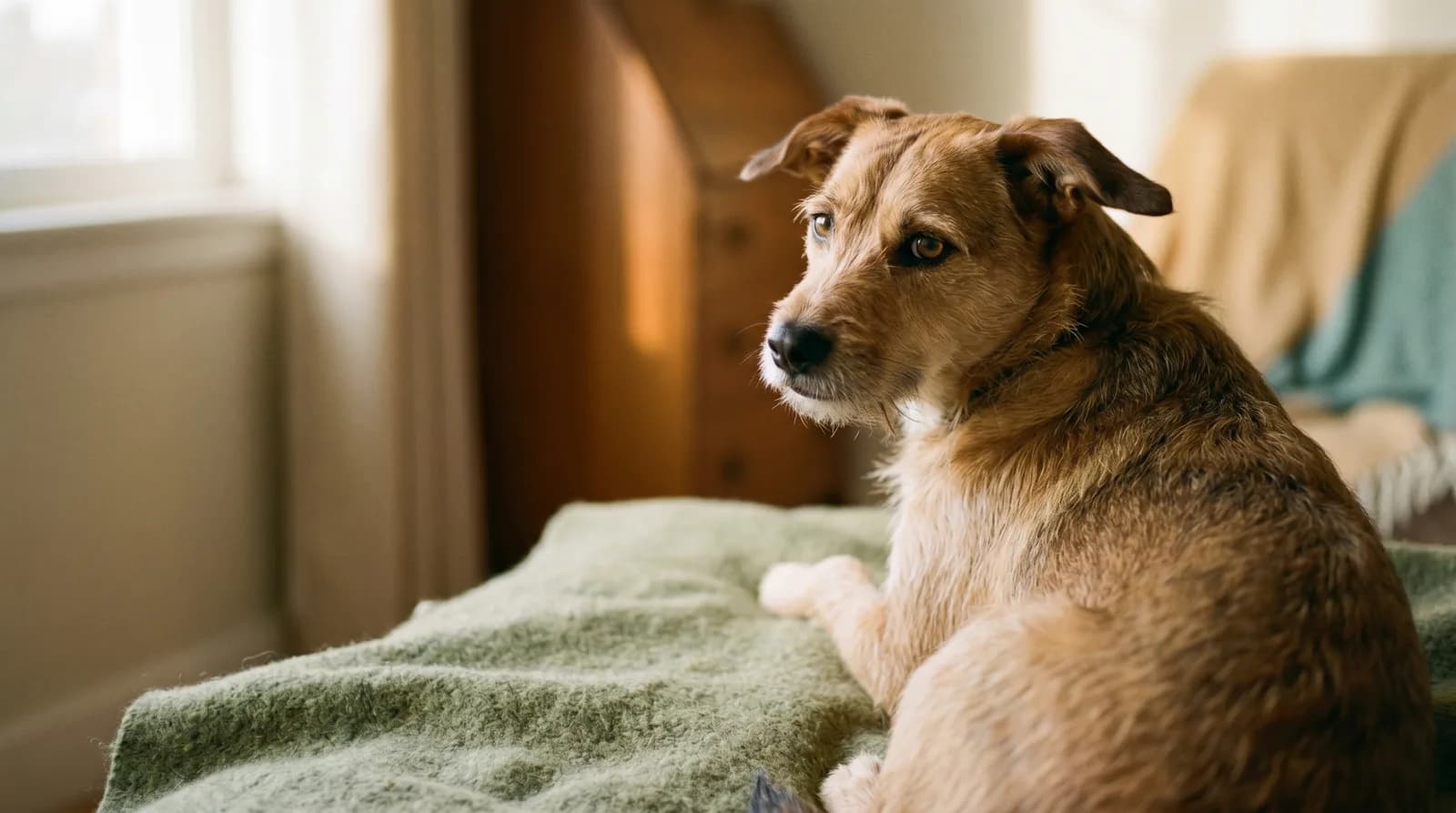
You did a good thing. You brought home a dog who needed someone, and now he is wedged behind the sofa, won't look at you, and hasn't touched the lovely dinner you put down. If your chest is tight with the thought that maybe you have done something wrong, please breathe. You haven't. This is what the first month with a fearful rescue dog very often looks like, and it is not a sign of failure. It is a frightened dog landing in a strange new world, doing the only thing that feels safe: getting small and waiting to see if it's safe to exist here.
Here is the thing to hold onto from day one. Your dog isn't naughty, and he isn't broken. He's scared, and that's fixable. The first weeks are not about training, tricks, or showing him off. They are about safety, space, and a quiet routine while his nervous system catches up.
What the first month with a fearful rescue dog looks like
We usually do not know much about where a rescue dog came from, and it helps to be honest about that. You can describe what you see in front of you, but you cannot read his history, and you do not need to invent a sad backstory to take his fear seriously. A dog can be deeply frightened by nothing more than the enormous change of losing everything familiar in a single day.
So expect a wobble. In the first days and weeks, a fearful rescue dog may:
- Hide, freeze, or press himself into a corner for hours.
- Eat little or nothing, or only eat when no one is watching.
- Flinch at ordinary sounds: the kettle, the vacuum, the garbage truck, footsteps on stairs.
- Refuse to go outside, or refuse to come back in.
- Avoid eye contact, or shadow you from a careful distance.
- Have accidents indoors even if he was clean before.
None of that is bad behaviour. It is a scared dog telling you, in the only language he has, that the world feels like too much right now. If you want to get fluent in reading those quieter signals, our guide to the signs of anxiety in dogs walks through exactly what worry looks like before it tips into a meltdown.
Decompression comes before everything else
There is a word that rescue folks lean on a lot, and it is worth knowing: decompression. It simply means giving a newly arrived dog a stretch of low-pressure, low-demand quiet so he can come down from the stress of the move before anyone asks anything of him. Think of it as the opposite of a welcome party.
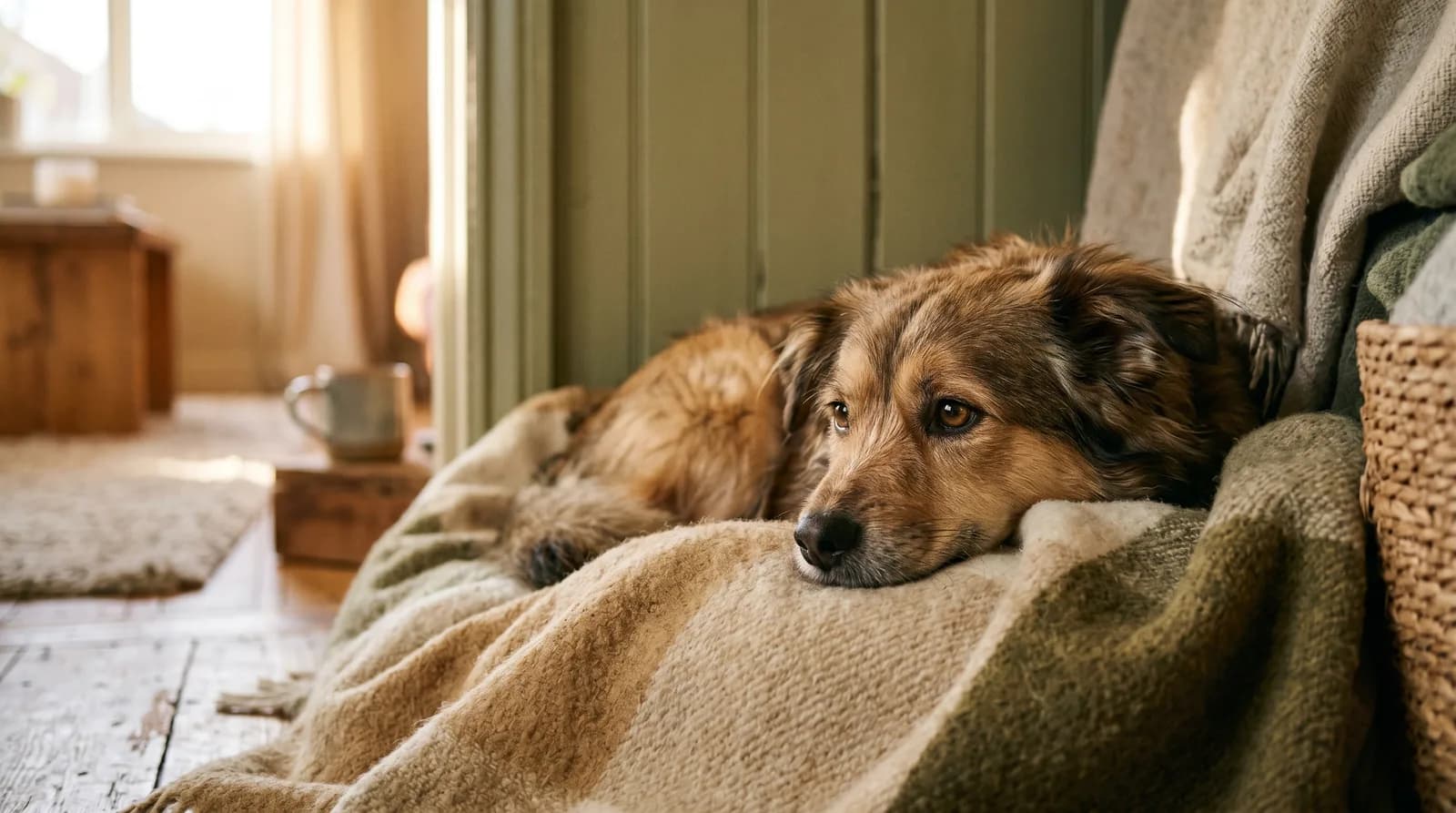
In practice, decompression looks almost boringly gentle. You set up one safe, cosy spot that is always his, a covered crate or a bed tucked in a calm corner, and you let it be a place no one ever disturbs, especially children. You keep the house quiet. You move slowly. You resist every urge to coax him out, photograph him, or introduce him to the neighbours. The kindest thing you can do in week one is less, not more.
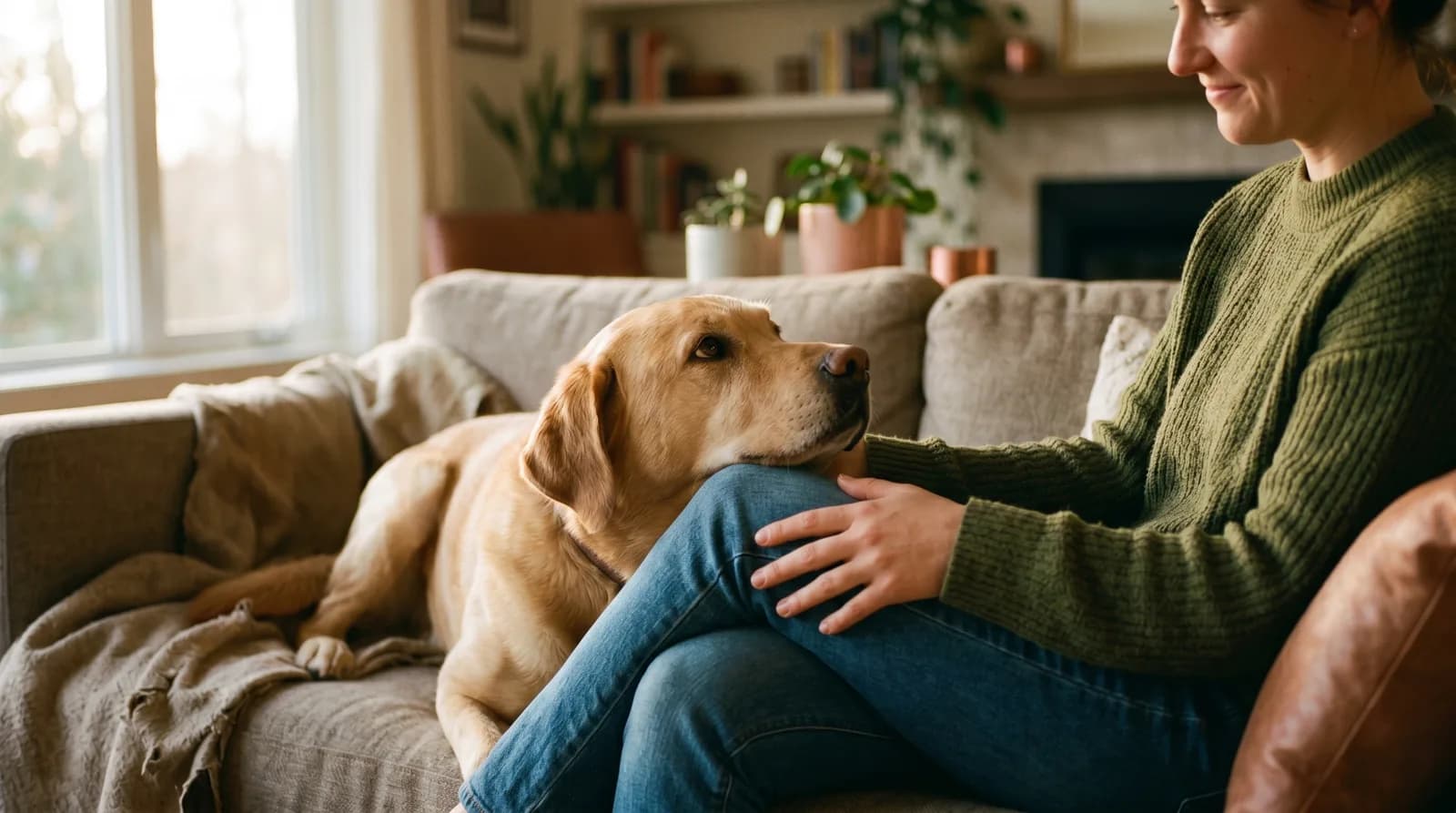
Give him the choice in everything you can. Sit on the floor a few feet away and read aloud or just breathe, without reaching for him. Let him approach you rather than the other way round. When he chooses to come a little closer, that is worth more than any cue you could teach him, because it is the first brick of trust.
Food, walks, and the quiet routine
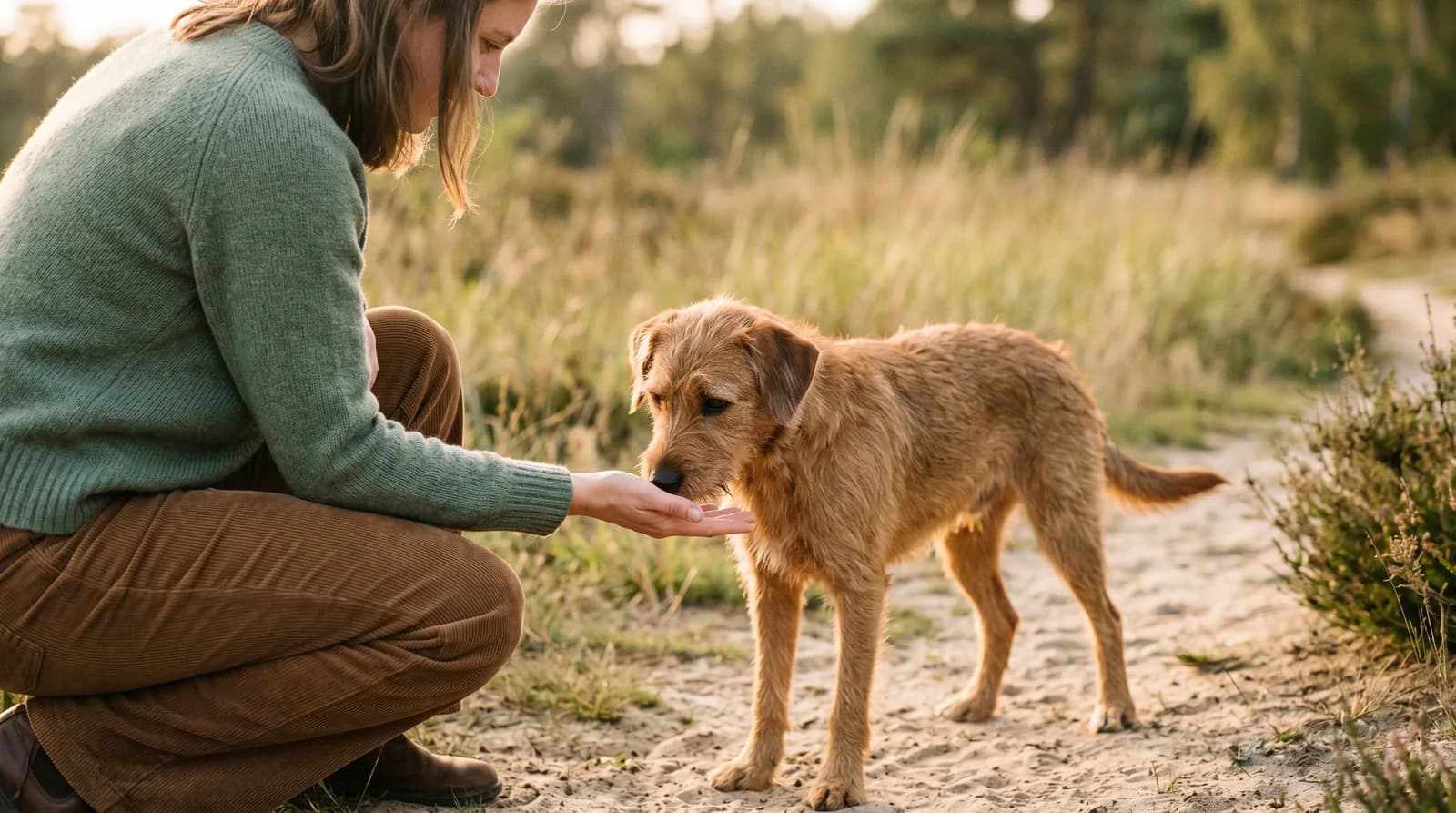
A scared dog often won't eat from a bowl in the open, so make it easy. Offer food in his safe spot, in a low-traffic part of the house, then walk away and let him try in private. Eating from the floor or from your flat hand is completely fine. Appetite is one of the first things stress switches off, and one of the first things to return as he settles, so it doubles as a quiet gauge of how he's doing.
Walks are where a lot of new owners feel the pressure, the sense that a proper dog should be trotting happily round the block by now. Let that go. For a frightened dog, the outside world is loud, fast, and full of strangers, and a short shuffle to the garden may be plenty at first. If he plants himself and won't move, don't drag him. Stand still, stay soft, and let him gather himself. Use a well-fitted harness with the leash clipped on indoors too, for a few days, so a startled bolt out of an open door doesn't become a lost dog.
Predictability does the heavy lifting here. Meals, rest, and the few small outings you do attempt, all at roughly the same times, tell a worried dog that the world has edges he can rely on. That steady rhythm does more in the first month than any training session could.
When the wobble is normal, and when to get help
Most of this settles with nothing more exotic than time, space, and patience. Many people find their dog softens in stages: a little braver after the first few days, more tuned into the household after a few weeks, more like himself after a couple of months. A very frightened dog can take longer still, and that is genuinely okay. If you want a gentle, step-by-step framework for the quiet weeks ahead, our guide on how to calm an anxious dog lays out the same force-free approach in more detail. Progress in these weeks is measured in inches, one step further out of the corner, one tail wag, one meal eaten while you are in the room.
It also helps to remember why the gentle approach works. You cannot punish a feeling away, you can only teach a dog to hide it. So you never tell him off for being scared, you never force him toward the thing that frightens him. You lower the pressure, reward the brave little choices, and let safety do the heavy lifting. If you want the full picture of why fear responds to kindness and not correction, the mindset behind all of this lives in your dog isn't naughty, he's scared.
There is no prize for rushing. The dog you hoped you were adopting is almost always the same dog in front of you now, just buried under fear that hasn't worn off yet. Give him a quiet room, a steady routine, and the gift of being left alone to decide when he's ready, and he will start, in his own time, to show you who he is.
If his fear is severe or comes on suddenly, if he stops eating for more than a day or two, or if there is any growling, snapping, or bite risk, please loop in your vet or a qualified force-free behaviour professional who can help you do this safely. This is training guidance, not veterinary or medical advice.