If your dog is nervous of other dogs, or people, or the wide loud world, you have almost certainly been told to "just socialize him more." Take him to the dog park. Let him say hello. Make him face it. And if socializing a scared dog that way has only ever made things worse, please hear this first: you did not fail him. You were handed advice that was wrong for the dog in front of you.
Why "more socialization" so often backfires
The advice makes a kind of sense for a confident puppy meeting the world for the first time. It is the opposite of helpful for a dog who is already scared.
Here is the problem. When you walk a frightened dog into the middle of the thing he fears, the noise, the crowd of dogs, the stranger reaching for him, he does not have the option to leave. He is over what trainers call threshold: the point where he notices the scary thing but can no longer eat, think, or settle. Above that line, he is not learning that the world is safe. He is just surviving it.
This has a name. It is called flooding: forcing a dog over threshold and hoping he gets used to it. Sometimes a flooded dog goes quiet and still and people read that as "see, he calmed down." He did not calm down. He shut down. And each time it happens, his brain files away one more bit of evidence that other dogs, or people, or the park, mean a flood of fear with no escape. The thing you were trying to fix gets stronger.
So if every trip to the dog park ended with a more frantic, more reactive, more exhausted dog, that was not your dog being stubborn. That was flooding doing exactly what flooding does.
Flooding versus gentle exposure: the real difference
Both flooding and the kind, effective approach involve exposing your dog to the thing he fears. The difference is everything, and it comes down to one word: distance.
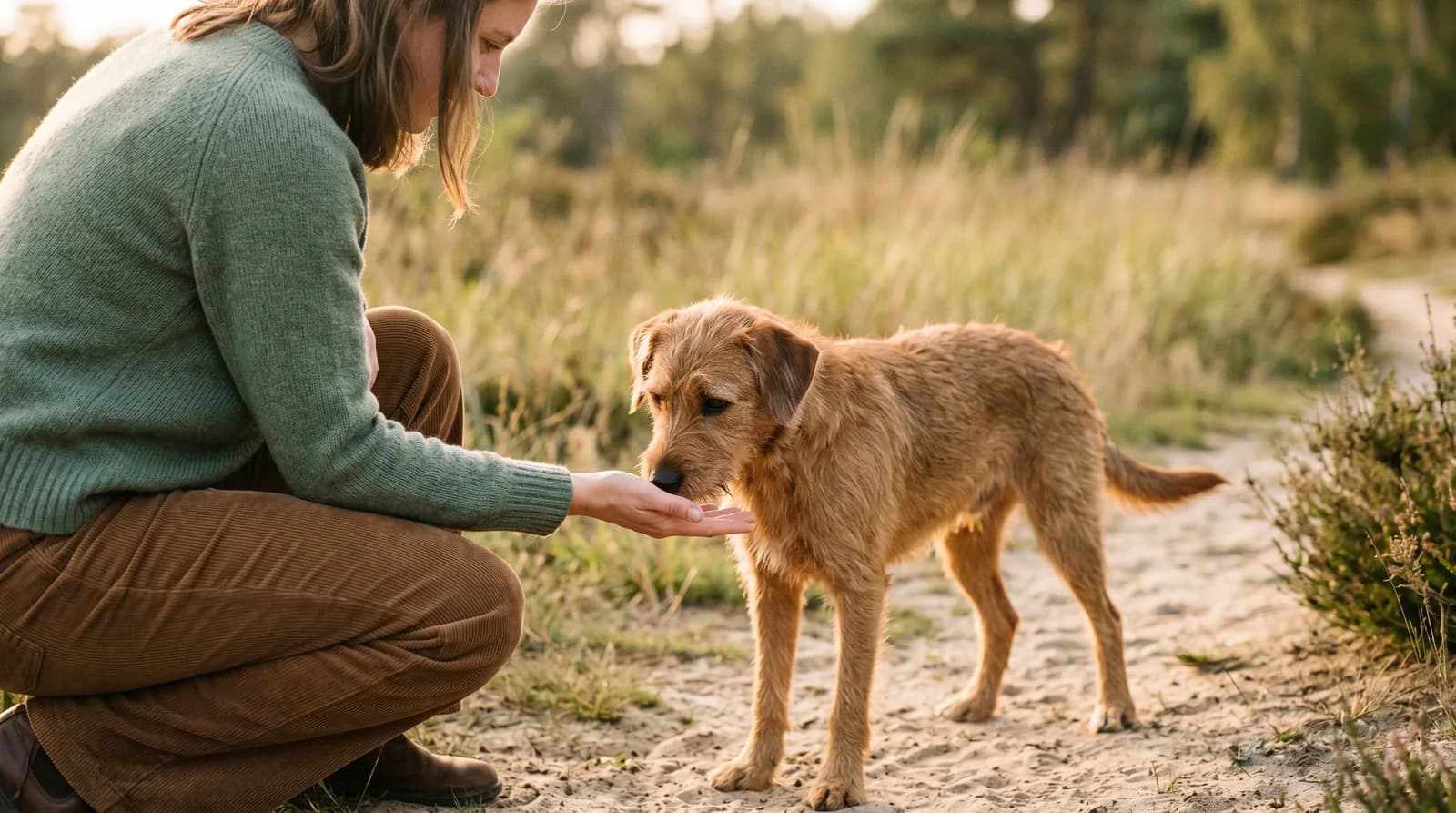
Flooding puts the scary thing right in his face at full strength and waits. Gentle, gradual exposure does the opposite. It lets him meet a tiny, watered-down version of the scary thing, far enough away that he can still take food, still glance at it and look back at you, still breathe. Then, over many small reps, you pair that low-level version with something wonderful, a piece of chicken, a favorite game, so "another dog in the distance" slowly turns into "oh good, snacks happen now."
That gentle pairing is desensitization and counterconditioning, and it is the actual engine of change for a scared dog. It is patient and a little boring and it works, which is more or less the opposite of dragging him into a dog park.
A simple way to feel the difference: flooding asks your dog to cope. Gentle exposure makes sure he never has to, because you keep him under threshold where coping is not required. We walk through the whole calm approach, threshold, desensitization, building confidence, in our guide on how to calm an anxious dog.
The kinder way of socializing a scared dog: read his limit
The skill that protects your dog is learning to read the moment he tips over, ideally before he gets there.
A few signals that he is at or past his limit:
- He won't take food he normally loves. This is the big one. A dog who refuses chicken is a dog who is too worried to eat, which means he is too worried to learn.
- He goes stiff, still, or frozen, or fixates hard on the scary thing and can't look away.
- Lip licks, yawns when he isn't tired, a tucked tail, ears pinned back, a whale-eye showing the whites.
- He can't respond to a cue he knows perfectly well at home.
- He goes the loud way instead: barking, lunging, spinning at the end of the leash.
When you see these, he is not being difficult and he is not "almost over it." He is over threshold and asking for distance. The kindest, most effective thing you can do is calmly add space until he can eat and think again. Learning to spot the quiet early signals, before the meltdown, is genuinely the highest-leverage skill there is, and our guide to dog anxiety body language shows you exactly what to watch for.
A kinder plan than the dog park
So what do you do instead of "more socialization"? You do less, on purpose, and you do it well.
Start where he is comfortable, not where you wish he was. If he can cope with another dog two hundred feet away but not at fifty, then two hundred feet is your starting line, and that is fine. Reward calm. Keep sessions short. End while he is still doing well, never when he is fried. Let him watch the world from a safe distance rather than be plunged into it, because a dog who gets to observe on his own terms is a dog who is quietly learning that he is okay.
And let go of the idea that he needs to greet everyone and everything to be "well socialized." For an already-scared dog, the goal is not more hellos. It is feeling safe enough in the world to relax in it. A calm walk where he never went over threshold beats an hour at the dog park every single time.
This all comes back to the reframe that changes everything: your dog isn't naughty, he's scared, and that's fixable. The barking and the bolting at the park were never bad behavior to be corrected out of him. They were a scared dog telling you it was too much. We unpack that mindset shift in your dog isn't naughty, he's scared, and it is worth a read before your next walk.
You were not the problem. The advice was. And the gentler path, distance, patience, small wins, is not only kinder, it is the one that actually gets you the calmer dog you have been hoping for.
If your dog's fear is severe or comes on suddenly, or if there is any growling, snapping, or bite risk, please loop in your vet or a qualified force-free behavior professional who can help you do this safely. This is training guidance, not veterinary or medical advice.