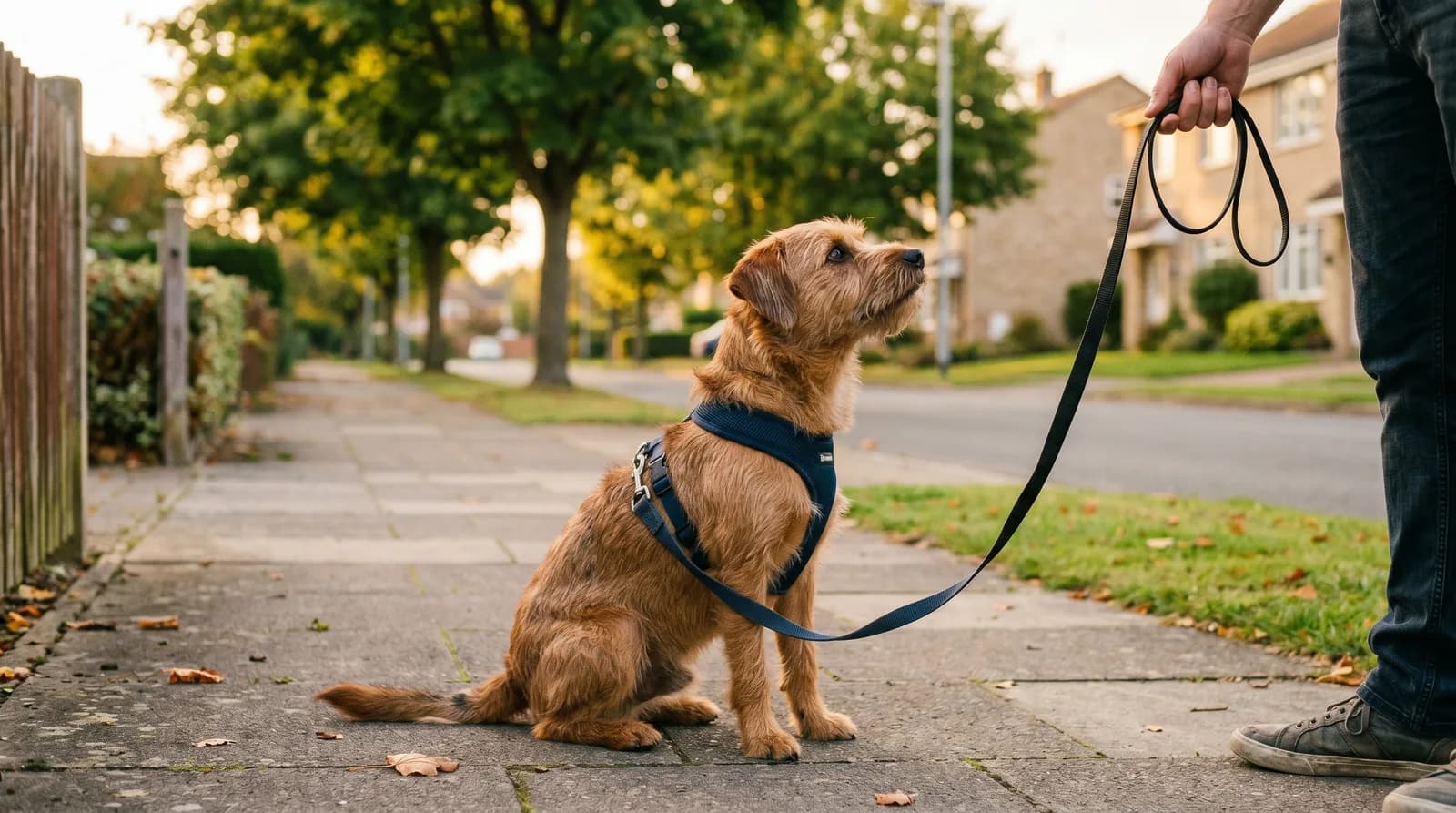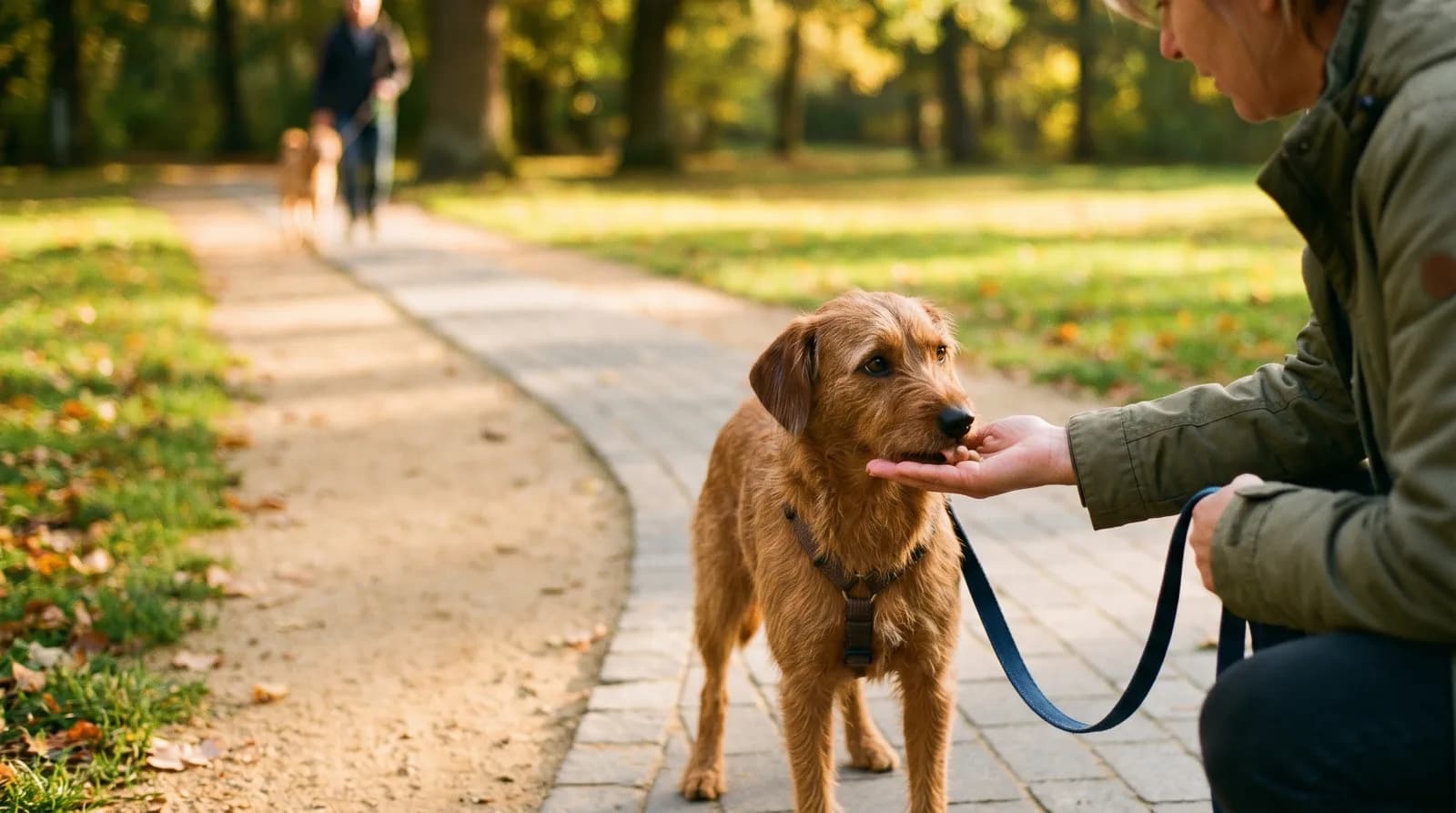
How long does it take to fix a reactive dog? For most dogs, the first real wins come within 2 to 4 weeks of calm, consistent practice, and a lasting change in how your dog feels about other dogs, people or bikes usually takes 3 to 6 months, sometimes longer. "Fixed" is a slippery word here, though: most reactive dogs become much calmer and easier to live with, and many still do best with a bit of everyday management for life.
If you crossed the street three times on this morning's walk and still ended up with a dog barking at the end of his leash (lead), it's a fair thing to ask before you commit to months of practice.
Why "fixed" is the wrong finish line
Reactivity is your dog feeling too much, too fast, when he sees something that worries or frustrates him. Training changes that feeling bit by bit. It doesn't flip a switch.
Dogs Trust is honest about this. Asked whether reactivity can be fully resolved, it says "There's no simple answer to this as every dog is an individual," and that for some dogs "ongoing management may still be necessary." It also reminds owners that "progress isn't a straight line."
A more useful goal than "fixed": your dog notices another dog across the street, looks, and turns back to you. He might still bark when a dog bursts out of a gate next to him, but he settles in seconds instead of half an hour.
How long does it take to fix a reactive dog? A realistic timeline
Here is what the first months often look like for a typical case. It's a composite, not a real client: a 3-year-old mixed breed who barks and lunges at other dogs on walks once they're within about 30 yards, and has never bitten. Your dog's pace will differ, so use the shape of it, not the dates.
| Stage | What you're doing | What you'll likely see |
|---|---|---|
| Weeks 1 to 2 | Changing walk times and routes, keeping lots of distance, a few days of quiet walks or sniffing games at home to let him settle | Fewer blowups, mostly because you're avoiding the close calls. You feel a little less tense. |
| Month 1 | Short daily sessions at a distance where he can see a dog and still eat: dog appears, food follows | He starts looking at dogs and then at you. The distance where he stays calm shrinks a little, say from 30 yards to 25. |
| Months 2 to 3 | Slowly working closer, practicing a U-turn and a "let's go" for surprise moments | Calm passes on the far side of the street. Bad days still happen, but he recovers faster. |
| Months 3 to 6 and beyond | Practicing in new places, at busier times, with different kinds of dogs | Most ordinary walks are uneventful. You stop planning your day around other dogs, while still giving him space in tight spots. |
The first weeks can feel like nothing but avoiding dogs. That's on purpose: you stop the old pattern before you build a new one. Progress also tends to come in steps with flat stretches in between, so a month where little seems to change is normal.
The step-by-step method behind this table is in our guide to when your dog barks at other dogs on walks, and the bigger picture is in reactive dog training.
What owners in our quiz told us
From more than 9,000 dog owners who took our free online quiz in 2026, most of them in Europe, two numbers stand out for this question:
- About half (51%) say the problem has been there "from the start." For many dogs this isn't a recent habit; it's how they've met the world since they came home.
- About 1 in 4 have dealt with it for more than a year. A pattern your dog has practiced daily for a year or more takes longer to change than one that started last month.
Most of them had already tried something. About 30% had worked with a trainer, about 30% had tried videos, 27% a course or group class and 20% books, while 28% said they'd tried "everything" and about 20% hadn't tried anything yet. Of those who tried, 45% said it didn't work, 32% said it helped a little, and 15% said it worked but came back. That's roughly 9 in 10 still stuck.
Owners also told us where things were heading over recent months: half said the behavior was staying the same, 1 in 5 said it was getting worse, and only 1 in 10 said it was getting better on its own. Dogs Trust says much the same: reactivity and aggression are "very unlikely to resolve by themselves."
A quick method note: these are self-selected owners who came to us for help, so the numbers describe dogs with a problem, not dogs in general.
Our reading: many attempts simply stopped too early. A six-week class covers roughly the first two rows of the table above, and if daily close encounters carry on afterward, the old pattern returns.
What speeds it up
- Distance first. Work where your dog can see the trigger and still take food and listen to you. If he can't eat, you're too close. Every session above that line is practice at reacting.
- Short, frequent sessions. Five to ten minutes most days beats one long weekend outing. Consistency matters more than intensity.
- Managing the rest of the week. Quieter walk times, routes with escape options, a car ride to an open field. Dogs Trust puts it plainly: "The more a dog practises a behaviour, the stronger it typically becomes." Fewer blowups means fewer reps of the wrong thing.
- Recovery days. After a rough encounter, a day or two of calm sniff walks or games at home gives his body time to settle before you train again.
What slows it down
Trigger stacking. The AKC describes it as a dog going through multiple stressful situations "within a short timespan." A delivery truck, then a skateboard, then a dog at 20 yards: by the third one, he has no patience left. The AKC adds that some dogs "may carry stress effects for days or even longer," which is why one bad Monday can make Wednesday harder too.
Rehearsal. Every lunge at the end of the leash is a repetition of the old habit. This is why the management in weeks 1 and 2 matters so much.
Pain. A sore back, hips or teeth can make a dog far less tolerant. A 2020 review in the journal Animals gave "a conservative estimate of around a third of referred cases" involving some form of painful condition, and Dogs Trust says that if pain is behind it and goes unaddressed, a dog's reactivity is unlikely to change. If the reactivity started suddenly, got worse quickly, or he flinches when touched, see your vet before you train.
Quick fixes. Corrections, prong or shock collars can make a dog go quiet for a while without changing how he feels, and the worry tends to come back. Writing for the Pet Professional Guild, behavior professional Theo Stewart calls quick-fix methods quick but temporary, and notes that "Too many dog owners give up after a good start." The slower force-free route is the one that lasts.
When to bring in a professional
If your dog has bitten a dog or a person, or you're worried he might, please don't work through this alone. Start with your vet, then find a qualified behavior professional, such as a veterinary behaviorist (DACVB), a certified applied animal behaviorist (CAAB) or a credentialed behavior consultant (IAABC). Keep walks quiet and well away from triggers in the meantime, and never punish a growl, because it's an early warning you want to keep. Our guide on how to tell a reactive dog from an aggressive one can help you judge the risk, and the timeline for a dog with a bite history is one to set with that professional.
A realistic next step
Pick one walk this week and make it easy: a quieter time, a wider route, a pocket full of food. Count how many times he sees a dog and stays calm. That number is your baseline, and it's how you'll know you're getting somewhere in a month.
If you'd like a week-by-week plan set around your dog's distance and your daily routine, you can take the free quiz and read how the plan works for leash reactivity. Your coach makes the plan with you, one step at a time.
This is training guidance, not veterinary or medical advice. If your dog has bitten or you're worried about bite risk, please work with your vet and a qualified behavior professional.