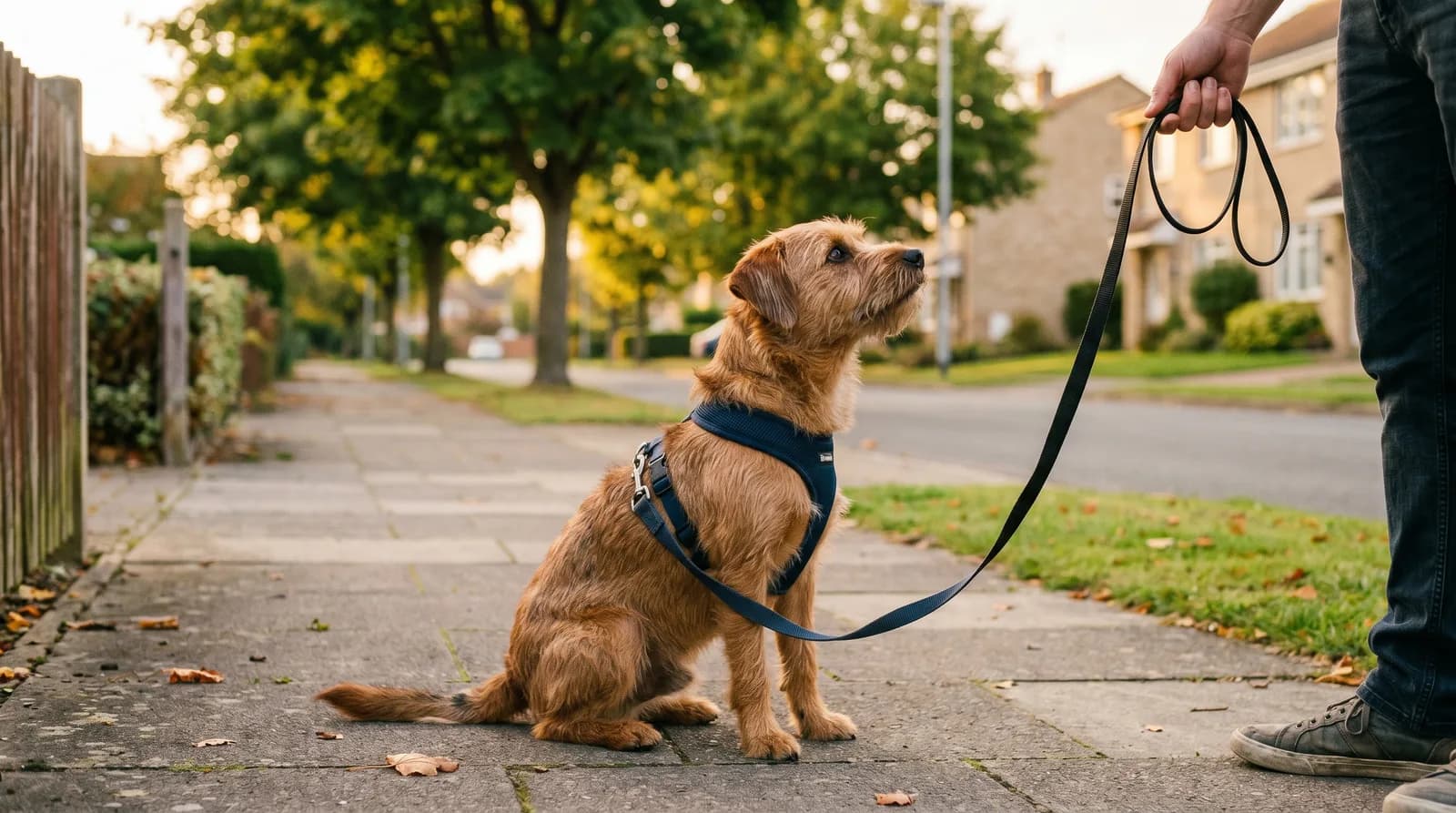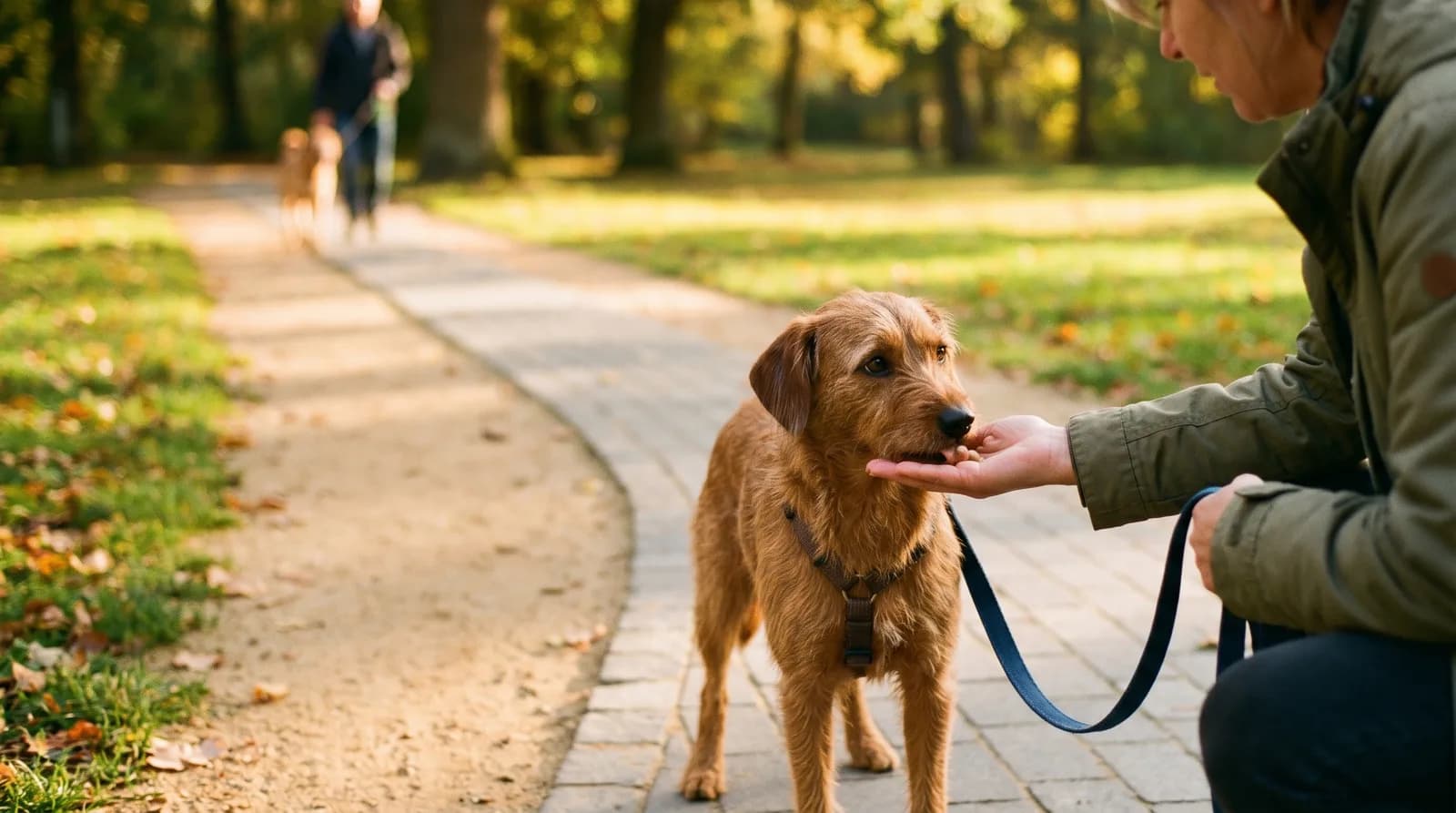
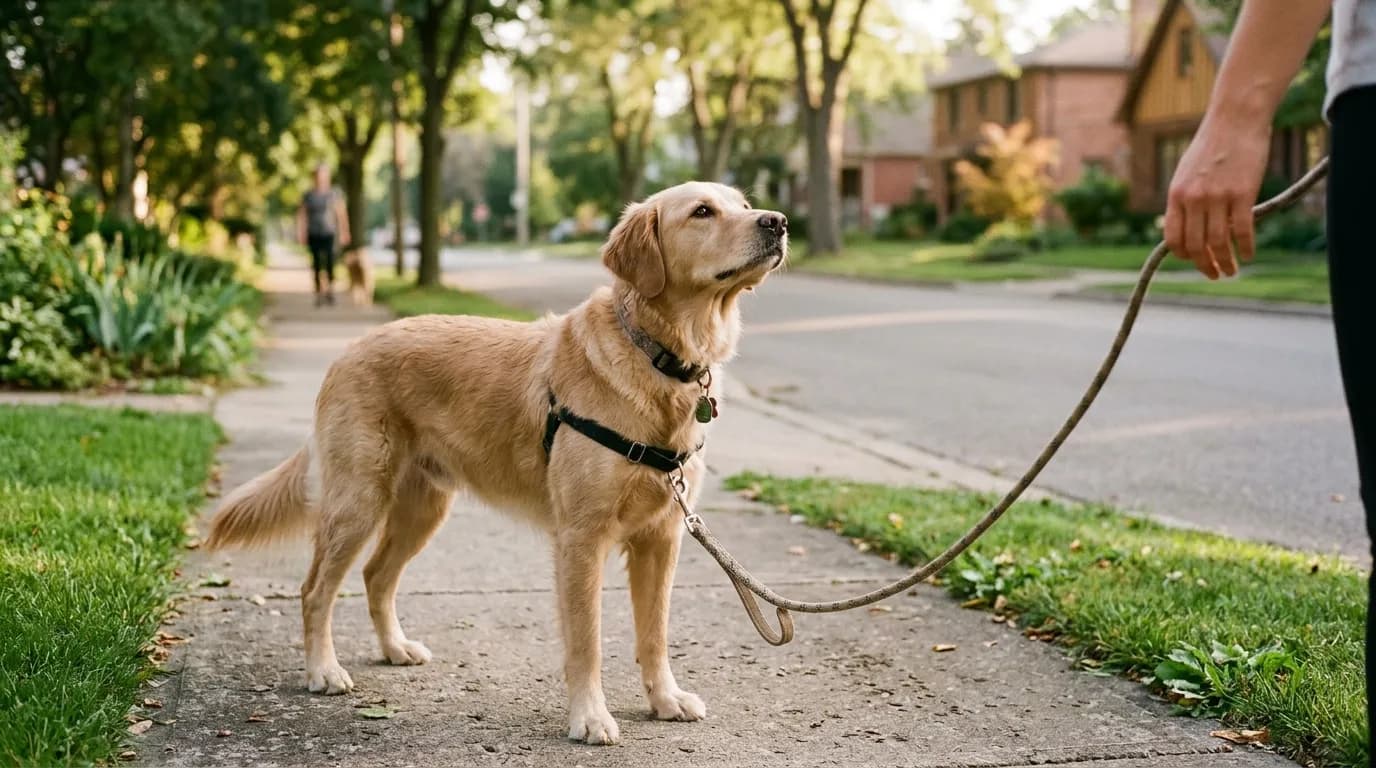
A reactive dog overreacts to everyday triggers like other dogs, bikes or strangers, mostly with loud barking and lunging that is meant to make space. An aggressive dog uses behavior meant to stop or drive off a threat, up to snapping and biting, and that is a safety issue to manage now and take to a professional. The line between reactive and aggressive behavior is blurry, so the most useful question is less "which label?" and more "how risky is this, and what does my dog need?"
If you're asking because your dog barked and lunged at a neighbor's dog and you suddenly felt like the owner of "that dog," you're not alone, and it may be less dire than it felt. Most dogs who make a scene on a leash are scared or frustrated, not dangerous.
Reactive vs aggressive dog: what the words mean
The American Kennel Club describes it like this: "Dogs who respond to normal, common occurrences with abnormal and excessive levels of arousal are often termed reactive." Aggression, the AKC says, is "a normal dog behavior which, depending on the context, can be adaptive or appropriate," and "most cases involve dogs trying to put distance between themselves and the target."
So both are usually about distance. The difference is mostly in how far the dog goes.
- Reactivity is a big emotional display: barking and lunging, often with hackles up. It looks scary, but the dog is mostly trying to make the trigger go away without contact.
- Aggression includes behavior that can cause harm: snapping, nipping, biting. It's not a character flaw or a "bad dog." It's a dog who feels he has run out of other options, and it needs a safety plan.
Many dogs sit somewhere in between, and a reactive dog can drift toward aggression. The AKC notes that reactive dogs, particularly fearful ones, can learn that aggression gets results.
Body language: how to tell them apart
Dogs almost always signal long before they bite. Behaviorist Kendal Shepherd's "ladder of communication," explained by the PDSA, runs from yawning, blinking and nose licking, through looking away, turning away and walking away, to "Stiffening up, staring," then growl, snap and bite. The higher up the ladder your dog goes, the more serious it is.
| What you see | Often means | What it tells you |
|---|---|---|
| Barking and lunging at the end of the leash, then settling once the trigger has passed | Reactivity (fear or frustration) | Usually a distance problem. Training helps a lot. |
| High-pitched barking, pulling toward other dogs, wiggly body | Frustration ("I want to get there") | Common in dogs who loved greeting as puppies |
| Hiding behind you, tail tucked, barking while backing away | Fear | He wants space, not a fight |
| Freezing, going stiff, hard stare | A step up the ladder | Give space right now. Don't push closer. |
| Growling, showing teeth, snarling | A clear warning | Respect it. It's communication, not disobedience. |
| Snapping or nipping, even without a mark | Aggression | A safety issue. Manage and get professional help. |
| A bite that bruises, punctures or tears skin | Aggression | Manage carefully and see your vet and a qualified professional now |
If you'd like to read the smaller signals better, our guide to dog anxiety body language goes through them one by one.
When it's a safety issue
Professionals often use the Dunbar dog bite scale to describe how serious a bite was. Level 1 is "Obnoxious or aggressive behavior but no skin-contact by teeth." Level 2 is "Skin-contact by teeth but no skin-puncture." From Level 3 up, the bite punctures the skin. Dunbar notes that "Levels 1 and 2 comprise well over 99% of dog incidents." That's reassuring, but it doesn't make Level 1 or 2 nothing.
Please see it as a safety issue, and get professional help rather than training on your own, if any of this is true:
- Your dog has snapped at or bitten a person or another dog, with or without a mark.
- He growls, stiffens or snaps around children. The ASPCA calls dogs who are aggressive toward children, especially children in the family, the "most problematic."
- He seems to bite "out of nowhere," without the usual warnings first.
- The behavior started suddenly, or came with other changes, like not wanting to be touched or moving stiffly.
Until you've seen a professional, keep everyone safe with management, not training: keep children and visitors separated from your dog with gates or closed doors, walk at quiet times and places, give him lots of space, and don't put him in the situations that set him off.
Why a vet check comes first
Pain makes dogs shorter-tempered, just like people. A 2020 review in the journal Animals gives "a conservative estimate of around a third of referred cases involve some form of painful condition," and notes that in some instances "the figure may be nearly 80%." The RSPCA puts it simply: "For any behaviour problem involving aggression, it's important to have your dog checked by a vet."
Why punishing a growl backfires
It's natural to want to stop a growl on the spot, especially in front of other people. But the growl is the useful part. The RSPCA warns that punishing small signs like growling "may stop it," but if dogs "have no way of showing that they feel under threat they will hide their emotions," which can lead to what looks like "unpredictable" aggression where the dog "goes straight to biting."
Harsh handling also tends to make things worse. In a 2009 survey of owners at a veterinary behavior clinic, University of Pennsylvania researchers found that confrontational methods "elicited an aggressive response from at least 25 percent of the dogs on which they were attempted." "Alpha rolls" and hitting were among the worst. The American Veterinary Society of Animal Behavior says "aversive methods should not be used in animal training or for the treatment of behavior disorders."
So when your dog growls, thank him quietly in your head, calmly take him away from whatever worried him, and make a note of what it was.
What helps a reactive dog
If your dog barks and lunges but has never snapped or bitten, the outlook is genuinely good. Reactivity usually softens with calm, force-free practice: working at a distance where your dog can still eat and think, pairing the trigger with good things, and avoiding the close encounters that make it worse. Our reactive dog training guide explains the approach, and if other dogs are the main trigger, start with what to do when your dog barks at other dogs on walks.
You also don't need to feel ashamed about it. From more than 9,000 dog owners who took our free online quiz in 2026, most of them in Europe, 35% said they feel ashamed or embarrassed about their dog's behavior, and 15% said they feel scared of what might happen. (These are self-selected owners who came to us for help, so they describe dogs with a problem, not dogs in general.) If you're in that 15%, let that worry steer you to the right kind of help.
Who to see if you're worried
For aggression or any bite, please work with someone qualified in behavior, after a vet check:
- US: a veterinary behaviorist (find one through the ACVB directory), a certified applied animal behaviorist (CAAB), or a behavior consultant with an IAABC or CCPDT CBCC-KA credential. The ASPCA suggests asking about their experience with aggression specifically.
- UK: a practitioner on the ABTC register or an APBC member, usually through a vet referral.
Our guide to dog behaviorist cost explains what each of them does and what to expect to pay.
If your dog is reactive without any bite history, a structured plan you can follow at home is often enough. You can take the free quiz and see how the plan works for leash reactivity: your coach makes a force-free plan around your dog, week by week. If your dog has bitten, please start with a vet and a qualified behavior professional instead.
This is training guidance, not veterinary or medical advice. If your dog has bitten, snapped, or shows aggression toward people, children or other animals, please talk to your vet and a qualified behavior professional.