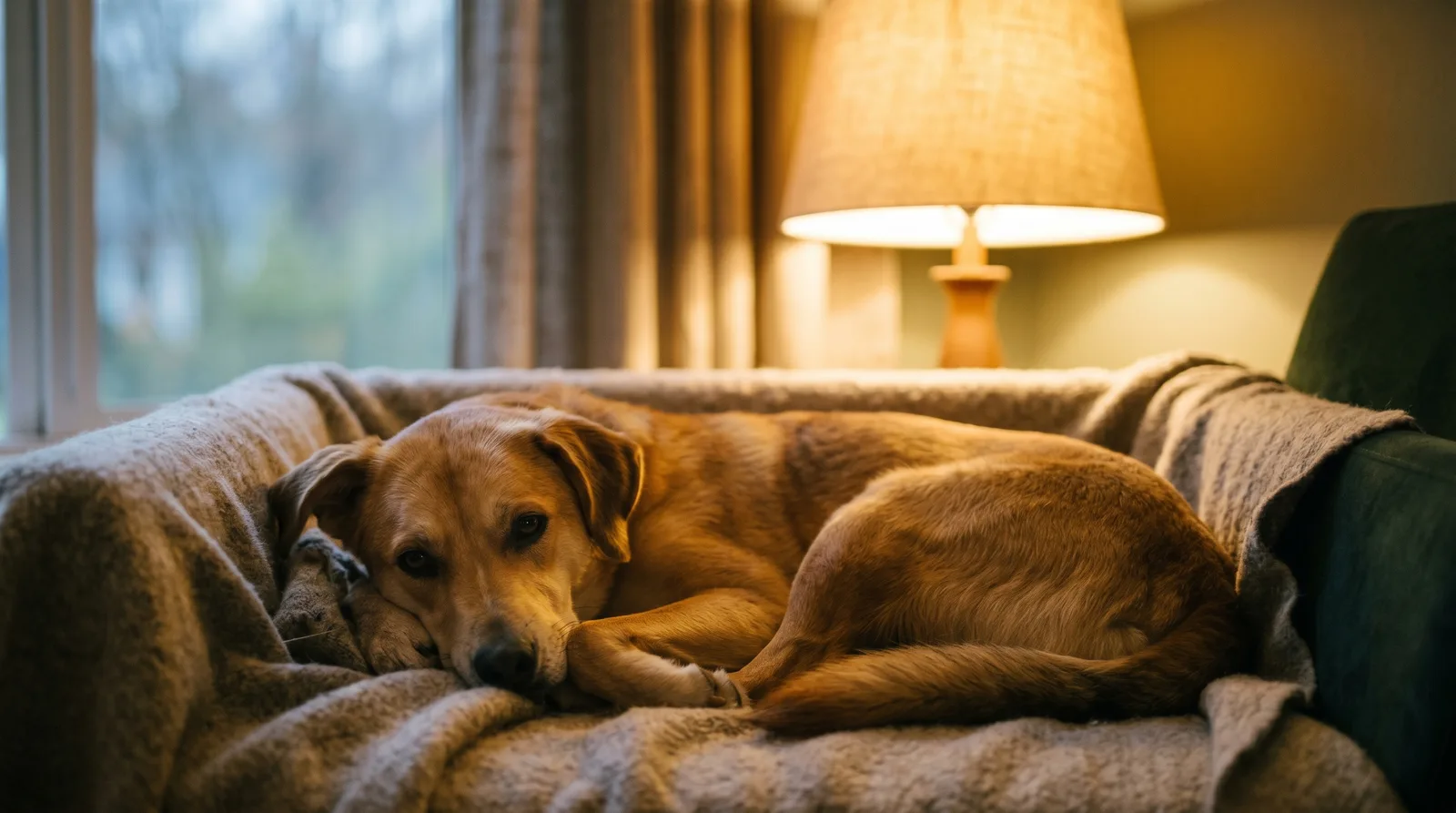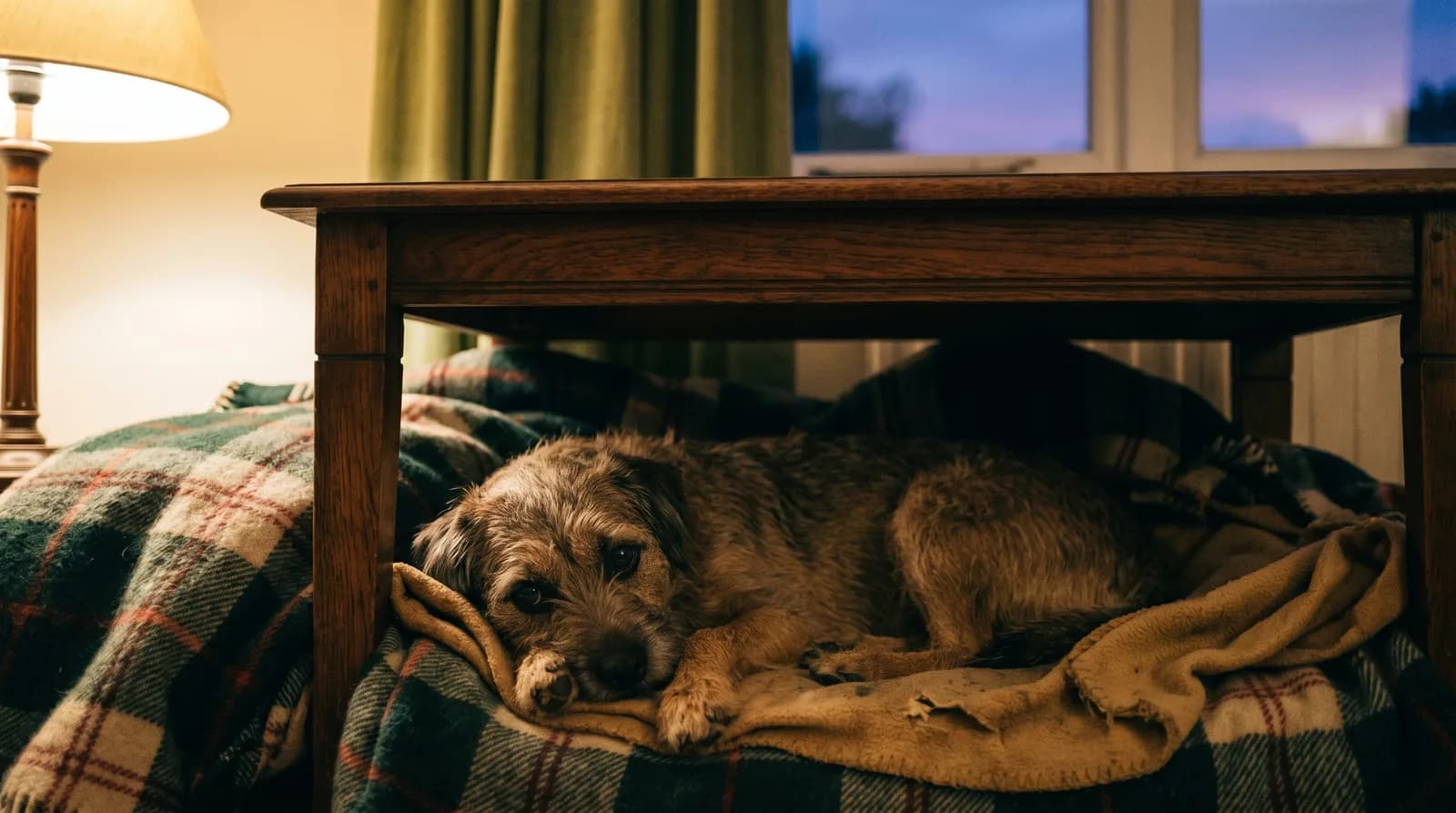
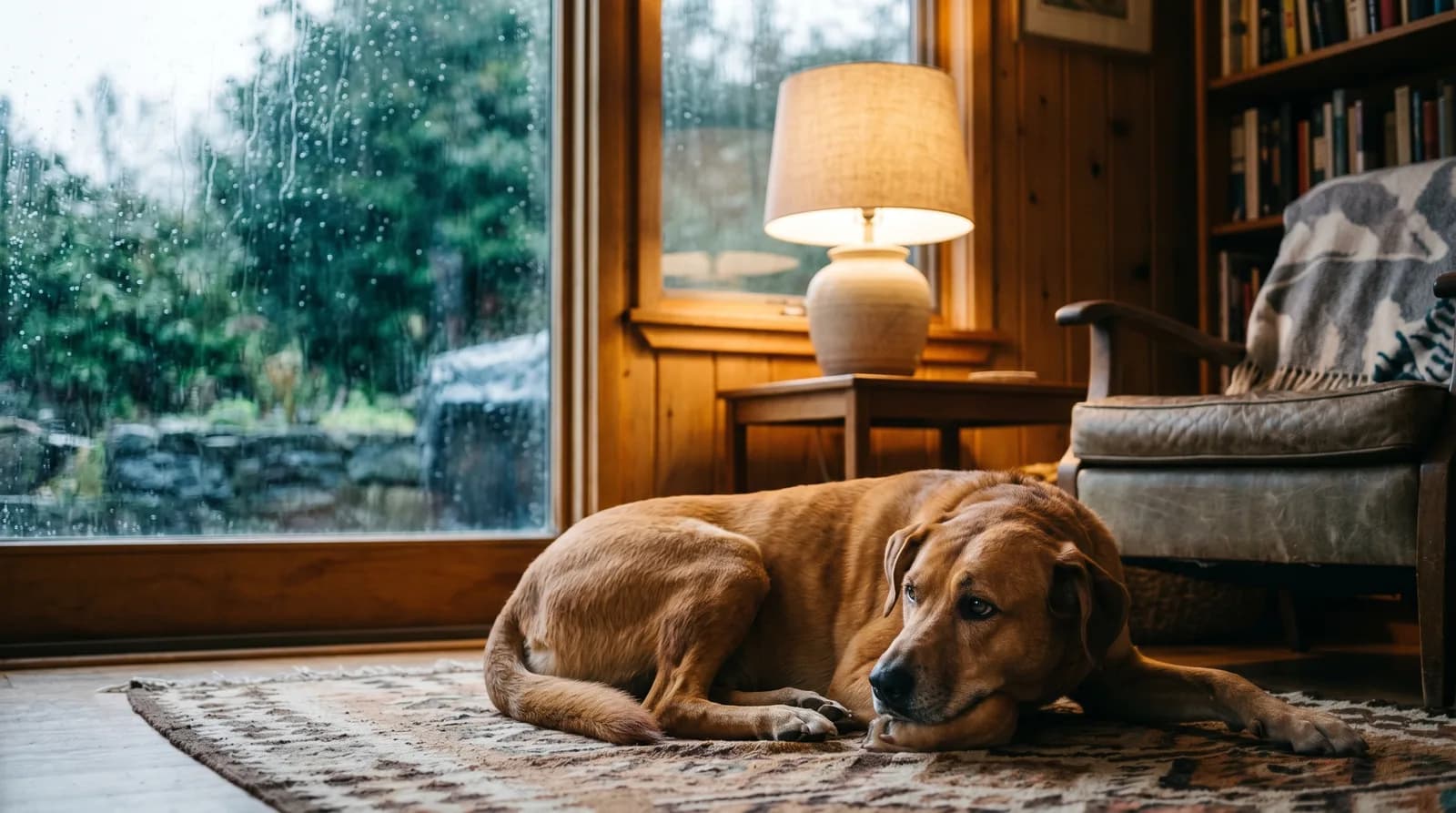
If your dog starts pacing and panting before you've even noticed the sky going grey, you are seeing thunderstorm anxiety in dogs up close. He hasn't suddenly turned clingy or naughty, he's scared, and his body is reacting to a storm that, to him, is already on its way. The good news is that thunder fear responds really well to a calm, force-free approach. Below is what makes thunder different from other scary sounds, a calm-down plan for the storm itself, and the longer game that makes the next one easier.
What makes thunderstorm anxiety in dogs different
Most loud noises are a single event: a bang, then it's over. Thunder is a whole production, and that's exactly why it gets under a dog's skin.
Long before the first clap, a storm sends out a wave of warning signals that your dog can read far better than you can:
- The pressure drops. The barometric pressure falls ahead of a storm, and many dogs seem to feel it.
- The air goes static. That charged, prickly feeling before a storm is real, and a sensitive dog may notice it.
- The sky darkens and the wind changes. Light, smell, and air movement all shift, and your dog picks up on all of it.
Put together, these cues mean a thunder-sensitive dog often starts to worry before anything you'd recognize as a storm. That's why he can be restless, shadowing you from room to room, or heading for his hiding spot while the weather still looks fine. He isn't overreacting to nothing. He's reacting to a build-up you simply can't sense.
Then comes the storm proper: long, rolling rumbles, sudden close cracks, and bright flashes of lightning, all unpredictable and impossible to escape. For a noise-sensitive dog, that combination is overwhelming.
Spot the build-up early
Because thunder announces itself, you get a head start the other noise fears don't give you. The trick is to read your dog, not just the weather.
Common early tells include pacing, panting, drooling, whining, trembling, sticking close to you, or quietly slipping off to a den or a corner. If you learn his particular pattern, you'll often know a storm is coming before the forecast does.
That early warning is a gift. The sooner you start settling him, the better he tends to cope, because you're helping him before he tips fully over threshold, the point where he's too frightened to eat, think, or settle.
On the night: a calm-down plan
When a storm is brewing, work through these steps. Lean on whatever helps your particular dog most, and start early rather than waiting for the first clap.
- Learn his early build-up signals. Watch for pacing, panting, shadowing you, or heading for a hiding spot. Those signs mean he's already picking up on the storm, so you can start settling him sooner.
- Make a safe den away from windows. Set up a covered crate or a quiet inner room with no windows. Add his bed and a worn shirt that smells like you, and leave it open so it never feels like a trap.
- Muffle the thunder and close the blinds. Steady background sound, a fan, the TV, or calm music, softens the rumbles, and closed blinds hide the lightning flashes. Bring his last toilet break forward so he's settled inside first.
- Offer calm chewing if he will take it. A stuffed lick mat, a stuffed Kong, or a long-lasting chew gives him something soothing to do. If he won't touch it, don't push it.
- Stay relaxed and let him choose closeness. Carry on as normal and keep your voice easy. If he wants to be near you, lean in. If he'd rather hide alone, let him.
- Do sound desensitization for the long game. This is the off-season work (more on it below) that genuinely changes how he feels about thunder over time.
Some dogs also find a snug body wrap comforting during storms, as one optional thing to try, never a fix and never forced on a dog who dislikes it.
If he's already over threshold
Some storms win, and your dog gets too frightened to eat, settle, or take anything you offer. That's your signal he's over threshold, and the plan changes: stop trying to tempt or train him, and simply keep him safe.
Don't force a chew, a wrap, or eye contact. Let him hide wherever he feels safest, sit nearby if he wants you, and dim as much of the chaos as you can. Check that doors and gates are latched, because a panicking dog may try to bolt. Your only job now is to be his calm anchor until the storm passes. If the fear is severe, your vet or a qualified force-free behaviour professional can help.
The long game: lowering his thunder fear for good
Management gets you through tonight. To actually change how your dog feels about thunder, the real work happens in the quiet, storm-free stretches in between.
That work is sound desensitization: playing thunder recordings at a tiny volume, far below the real thing, while something wonderful happens, like his dinner or a favourite game. Over many small sessions you raise the volume in tiny steps, always keeping him relaxed and below his threshold. Slowly, his nervous system rewrites "that sound means danger" into "that sound means good things." Our off-season sound desensitization guide walks through the volume ladder step by step, and the same principle works just as well for thunder.
Thunder also overlaps with other noise fears, so the broader picture helps too. For the full story of how fear of loud sounds works and how to soften it, see our pillar guide on dog noise phobia, fireworks, and thunderstorms. And if your dog struggles with fireworks as well, the calm-down steps in our guide on a dog scared of fireworks carry over almost completely.
You haven't done anything wrong, and your dog isn't broken. He's scared of something he can feel coming, and that's exactly the kind of fear a calm den, some patient management, and gentle off-season practice can ease. He isn't naughty, he's scared, and that's fixable.
This is training guidance, not veterinary or medical advice.