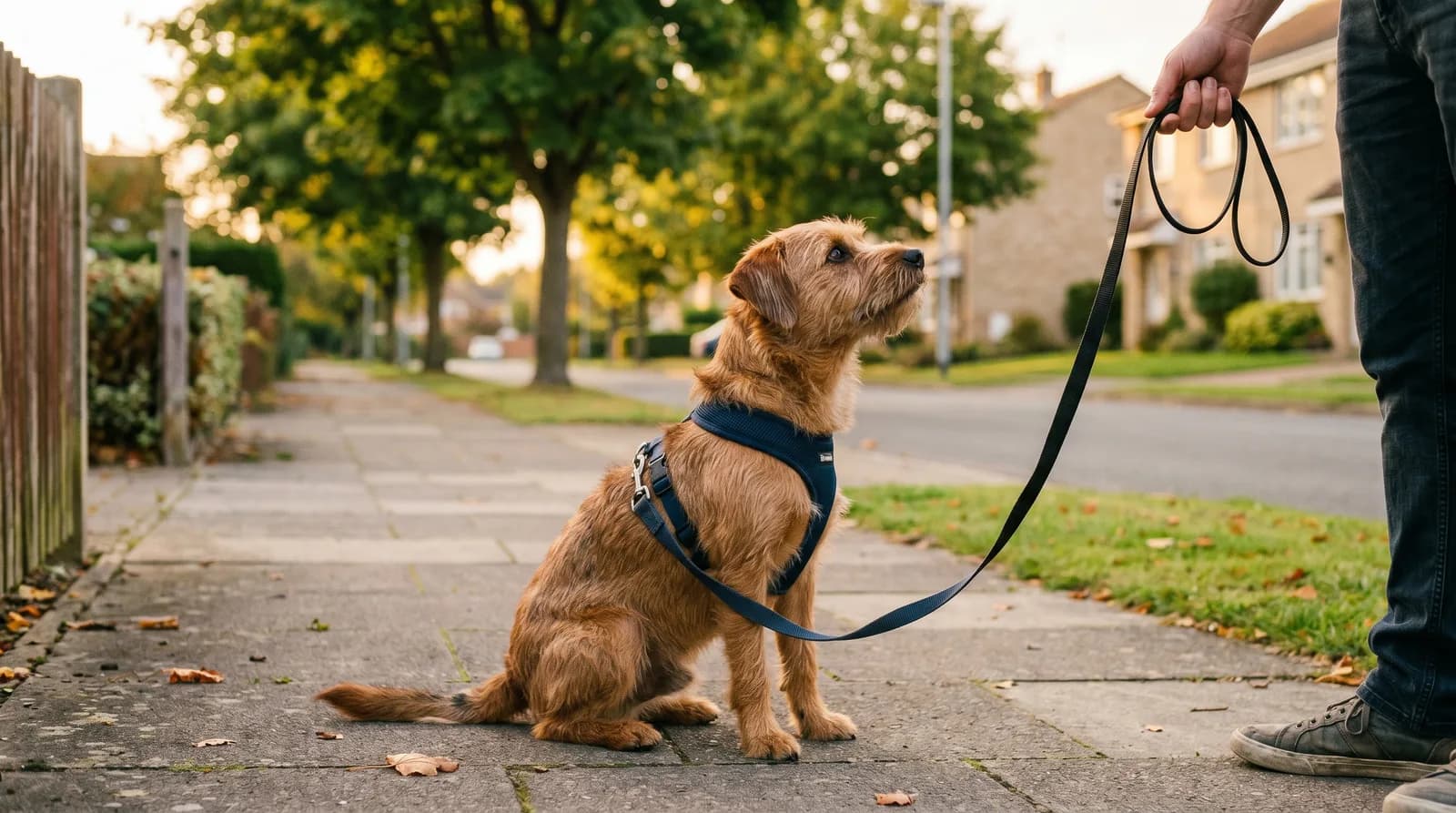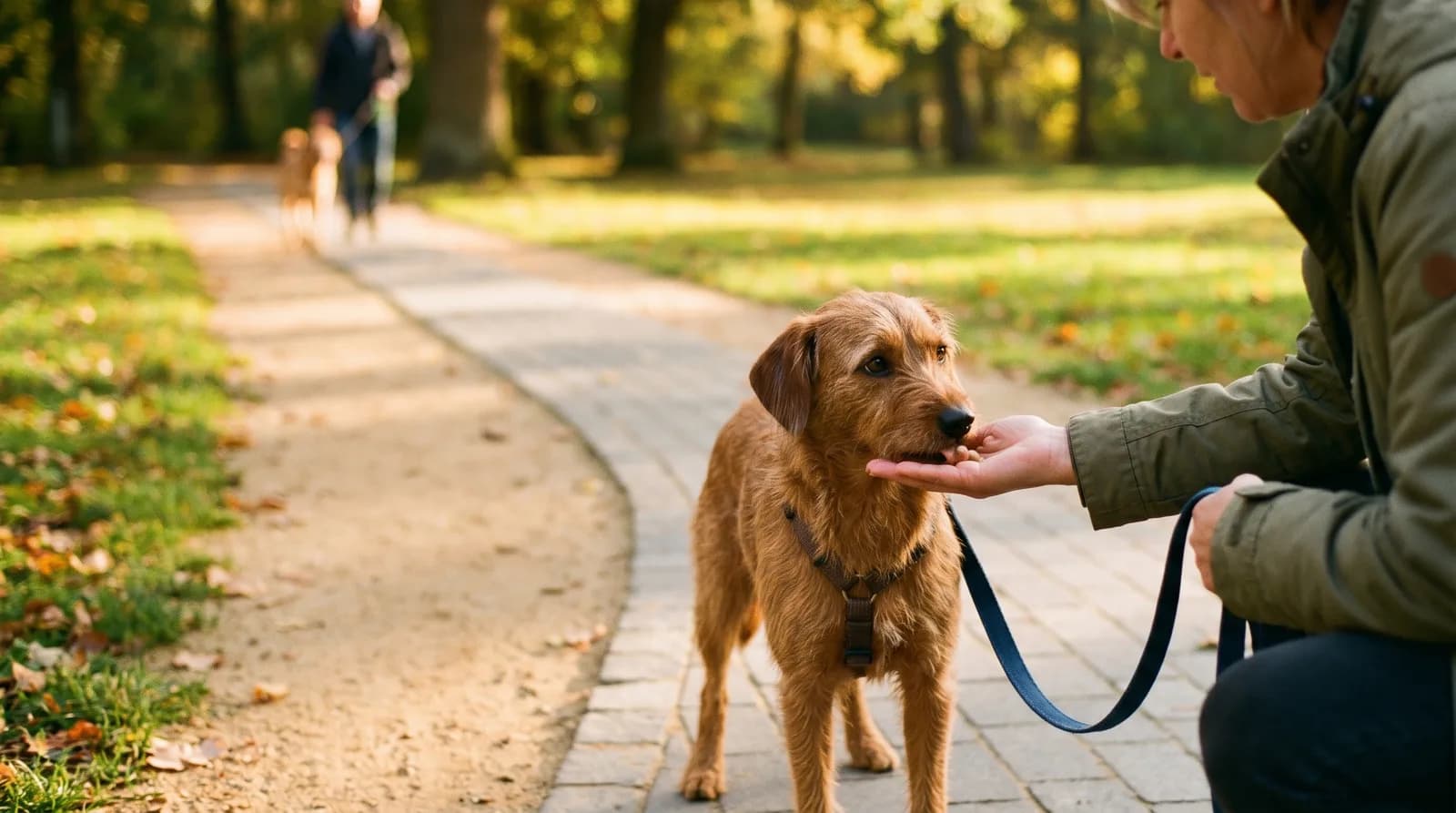
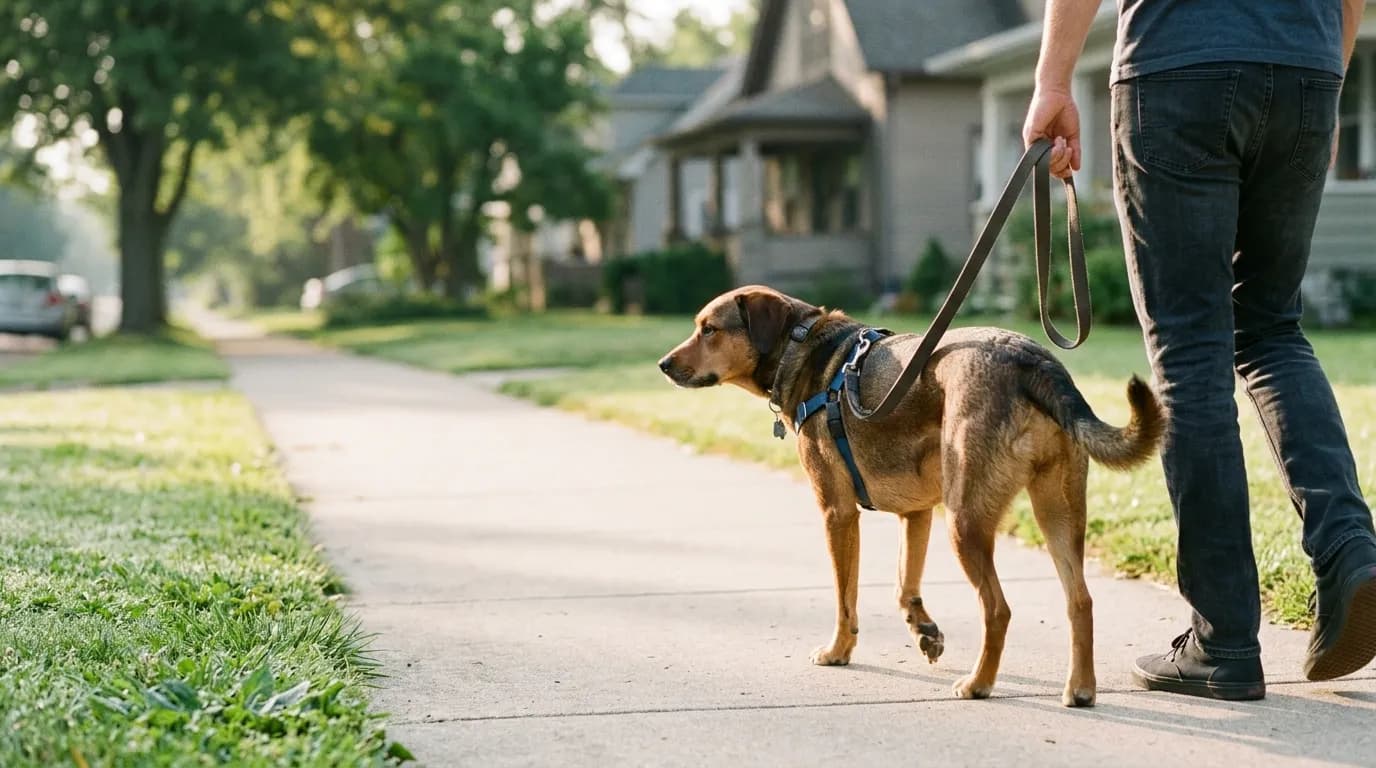
Board and train for reactive dogs is rarely the best first choice. Your dog may do well at the trainer's place, but reactivity lives in your street, your schedule and your hands on the leash, and those skills don't travel home on their own. If you're tired and tempted to send him away for three weeks, that's completely understandable.
What a board and train program is
Your dog lives with a trainer or at a facility for a set time, usually two to five weeks according to Preventive Vet, and is trained every day. At the end you get a handover lesson, sometimes a few follow-ups, and your dog comes home.
For basic manners in a confident dog, that can be a decent deal. Reactivity is a different problem. A dog who barks and lunges at other dogs is usually saying "that is too close, I don't feel safe." Changing that feeling takes many calm repetitions in the places where he actually meets his triggers.
What board and train for reactive dogs costs in 2026
Prices vary a lot by region and by how long the stay is. These are real US examples, most of them listed in 2026, so use them as a rough guide:
| Option | Example US prices | What you get |
|---|---|---|
| Board and train, 2 weeks | $1,500 to $2,900 in ThePricer 2026 examples; one provider charges $3,000 for 4 weeks | Daily training away from home, one or more handover lessons |
| Board and train, per week | may range from $500 to $1,250+ (Preventive Vet, 2024) | Same, priced weekly |
| Premium program, 14 to 28 nights | $3,509 to $8,929 (one Arizona program, Partners Dogs) | Boarded stay plus several weeks of follow-up day training and group classes |
| Day training, 8 sessions over 2 weeks | $600 to $1,700 (one vet clinic, ThePricer) | Trainer works with your dog, he sleeps at home |
| Private lessons | from $89 (PetSmart) to about $150 per hour in ThePricer examples | You and your dog, often on your own walking routes |
Two things are easy to miss. The Arizona program above includes its follow-up lessons in the price, but many programs don't, so ask how many lessons you get after your dog comes home. And that same program describes its behavior programs as "a 12 to 16 week arc total," which tells you that even the people selling board and train expect the real work to continue long after the stay.
In the UK, a January 2026 ManyPets price check of 25 trainers found that a week of residential training cost about £820 on average, from £450 in Derbyshire to £1,300 for a course in Surrey. Ask for the full price in writing, including every handover lesson.
Why reactivity rarely transfers from the trainer's place to your street
Dogs are poor at carrying skills between places
The American Kennel Club puts it plainly: "dogs don't generalize well." A dog who can walk past other dogs calmly on the trainer's quiet field hasn't automatically learned to do it on your sidewalk at 7am, with the neighbor's dog barking behind the fence. Best Friends Animal Society says the same: when the environment changes, dogs are "no longer sure of the behavior that is being asked of them."
You are part of the picture
Your timing, your tension on the leash, the route you pick and the moment you decide to turn around all shape how your dog copes. Preventive Vet calls the owner "the missing link" in a board and train. Your dog learned with someone else holding the leash. Now you have to learn the same moves, often in one or two handover lessons.
Kennels can be loud for a dog who struggles with dogs
A reactive dog may spend weeks hearing and seeing unfamiliar dogs. A 2014 study of 29 pet dogs found their cortisol was significantly higher in boarding kennels than at home. The researchers are careful to say this shows arousal, not necessarily distress, and some dogs find kennels exciting. Even so, a program that sells reactivity help, Partners Dogs, advises owners to avoid facilities where reactive dogs see or hear "a constant stream of unfamiliar dogs passing by." If you do book, ask exactly where your dog will sleep.
A typical story
Picture a 3-year-old mixed breed who lunges at dogs on walks. He goes away for three weeks and the videos look great: he walks past a calm demo dog at ten feet. He comes home, and on day four a neighbor's dog rushes a fence and he explodes. His owner doesn't know what the trainer did in that moment, so she does what she always did. Within a couple of weeks things look the way they did before. That pattern is common enough that a Baywoof guide written by a board and train owner warns that dogs can "behave perfectly with the trainer, then come home" and soon act "as if no training ever took place."
The methods question: quiet is not the same as calm
Some programs get fast, impressive videos by using prong collars, choke chains or shock collars. A dog who is corrected every time he reacts may stop barking. He may still feel just as scared, and now he has learned that showing it gets him hurt.
The American Veterinary Society of Animal Behavior says there is "no evidence that aversive training is necessary for dog training or behavior modification," and links aversive methods to "increased anxiety and fear-related aggression." A 2020 study in PLOS ONE found that dogs from schools using aversive methods showed more stress behaviors during training and bigger rises in cortisol afterward than dogs from reward-based schools. For a dog whose whole problem is fear, that matters. If someone tells you your dog needs to learn who's boss, our piece on the dominance myth explains why that idea doesn't hold up.
Red flags to check before you book
Dog training is unregulated: in the US, no state requires trainers to hold anything but a business license, and in the UK trainers and behaviourists are not regulated by government. So it's on you to check.
- A promise to fix your dog. The shared code of ethics of the IAABC, APDT and CCPDT says members shall refrain from guaranteeing training outcomes. Behavior can't be promised.
- Prong, choke or shock collars, including "remote training collars" listed as part of the package.
- Vague answers about methods. "We use whatever the dog needs" often means corrections are on the table.
- No visits allowed and no regular videos of training sessions.
- Talk of dominance, alpha or "pack leader".
- One handover lesson for a problem that took years to build.
Questions to ask
- Which tools will be on my dog, and can I see a full, unedited session on video?
- How do you work with reactivity specifically? (Listen for distance, counter-conditioning and staying below threshold.)
- Where does he sleep, and how many dogs can he hear from there?
- How many lessons do I get after he comes home, and are they on my own routes?
- What happens if he goes backward after a month?
When board and train can make sense
There are fair cases. An owner who is injured or recovering from surgery and truly can't walk the dog for a few weeks. A dog who also needs basic skills like loose-leash walking, which a good trainer can build quickly. A force-free program that spends serious time training you, with several lessons on your own streets. If you choose this route, choose it for those reasons, not because you feel you've failed.
If your dog has bitten or you're worried that he might, skip the residential route for now and start with a qualified behavior professional, such as a veterinary behaviorist or an IAABC-credentialed consultant, who meets you and your dog in your real life. Our guide to dog behaviorist cost explains who does what and what each charges.
What tends to work better for reactive dogs
You're not the only one who has tried things already. From more than 9,000 dog owners who took our free online quiz in 2026, most of them in Europe, about 3 in 10 had already worked with a trainer, and roughly 9 in 10 of those who had tried something said it didn't work, helped only a little, or came back. (These are self-selected owners who came to us for help, so they describe dogs with a problem, not dogs in general.) The plans that stick tend to be built on practice the owner can repeat every day.
- Day training or private lessons on your routes. The trainer works where your dog actually struggles, and you learn alongside.
- Short, calm sessions at a distance your dog can cope with. Five easy minutes beats one long, tense walk. Our step-by-step plan for a dog who barks at other dogs on walks shows how.
- Management while you train. Quieter times, wider routes, turning around early. Avoiding a bad moment is part of the work, not cheating.
- A plan that fits your week. Our reactive dog training guide covers the bigger picture.
If you'd like a written plan built around your dog and your routes, take the free quiz. DoggoPlan is a one-time, force-free plan ($59 in the US (£45 in the UK, €47 in Ireland, A$79, NZ$99, C$79)) that your coach makes around your answers, week by week, with a 60-day money-back guarantee. It's a lot cheaper than a stay away, and you stay the one holding the leash.
This is training guidance, not veterinary or medical advice. If your dog has bitten, or his reactivity is new or sudden, please talk to your vet or a qualified behavior professional first.