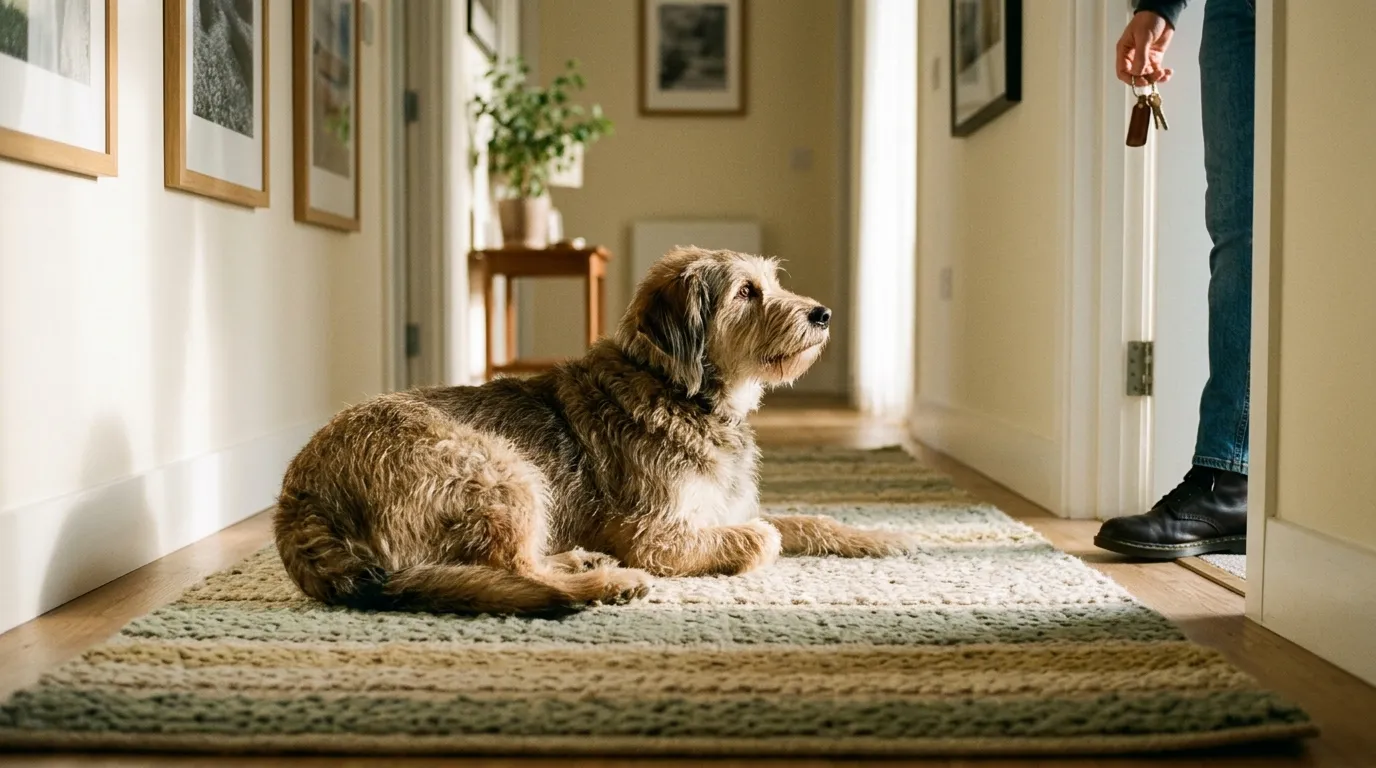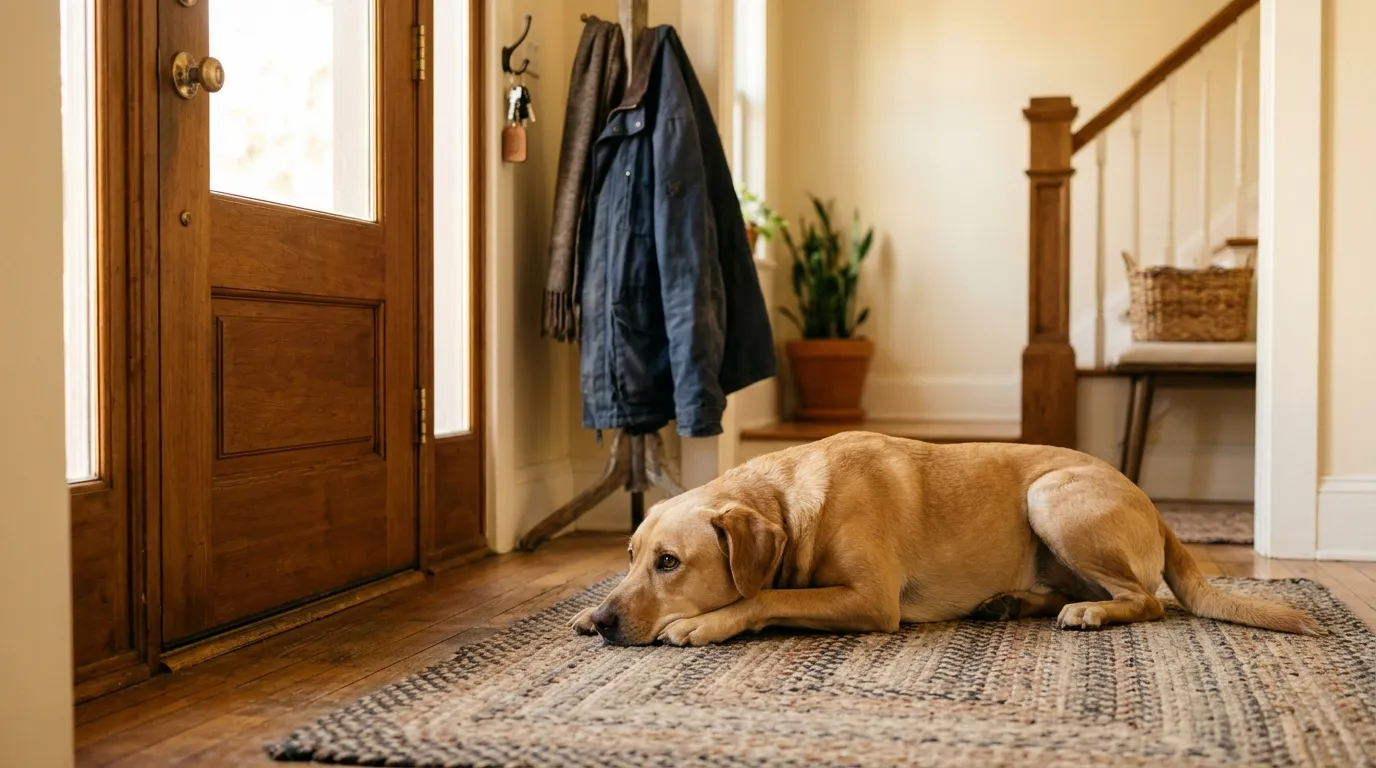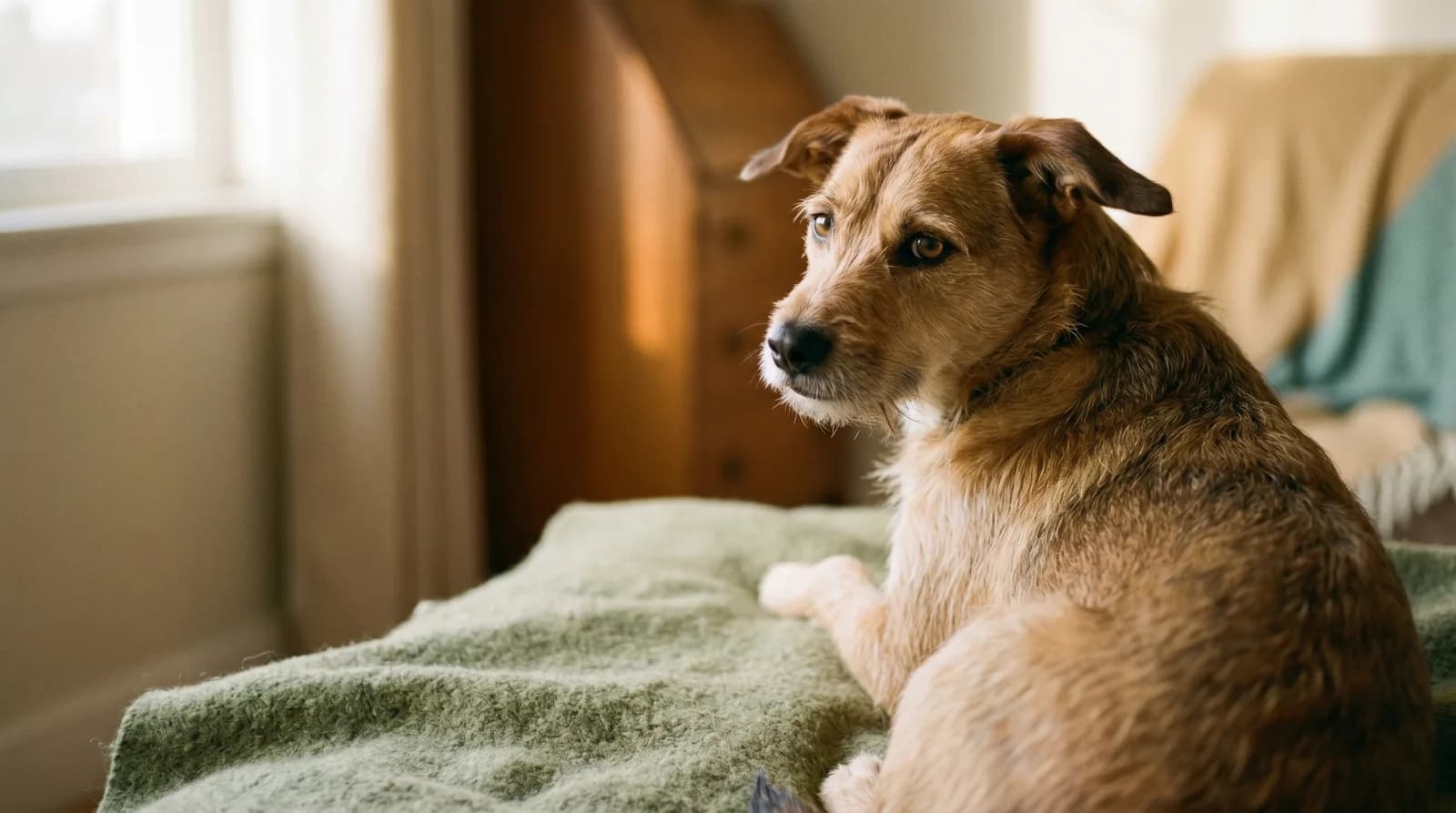
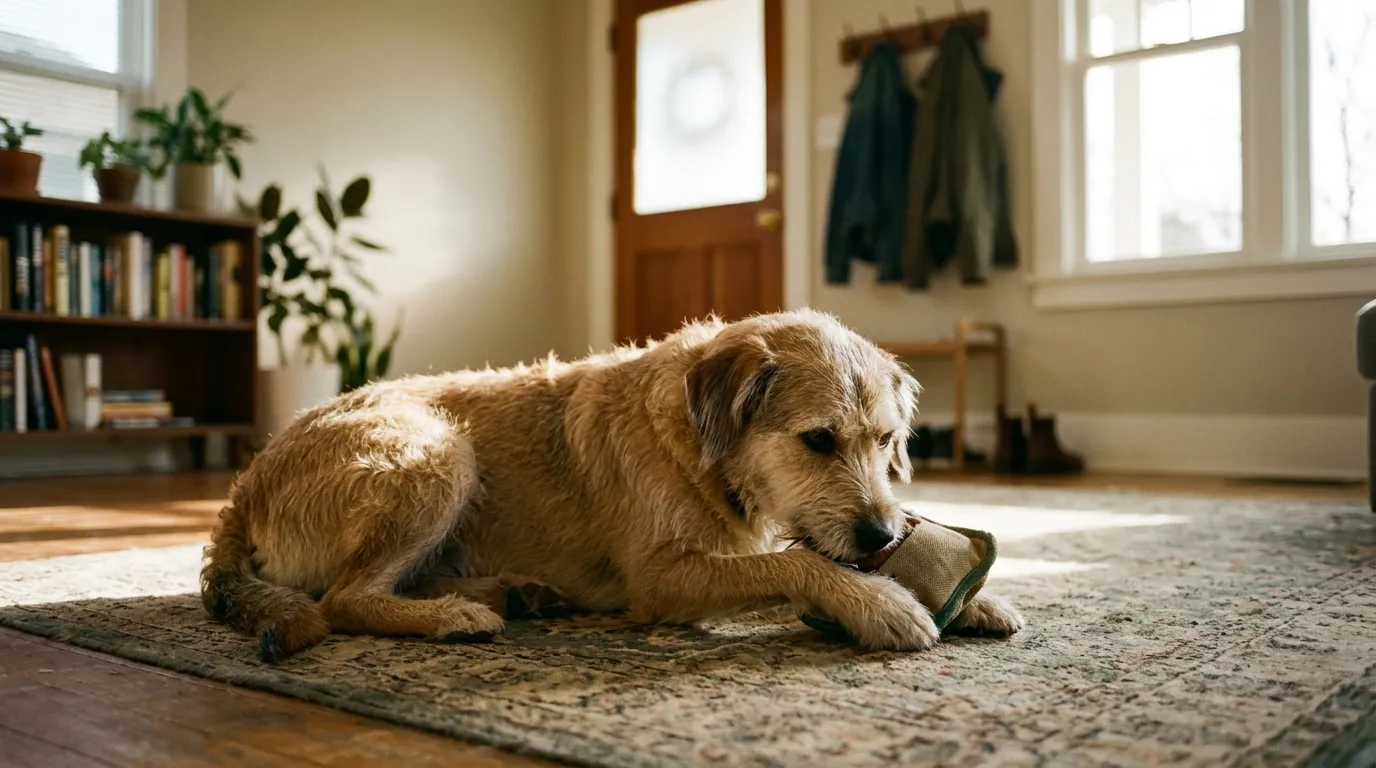
Separation anxiety in dogs is distress that starts when a dog is left alone, or is about to be: whining, barking, scratching at the door, pacing or accidents that happen only when you're gone, usually within minutes of leaving. It is a fear and frustration problem, not bad manners, and most dogs get better with slow, gradual absence training that keeps every absence shorter than the point where your dog gets upset.
If you've come home to a chewed door frame or a note from the neighbor about the howling, you're not a bad owner and your dog isn't getting back at you. The ASPCA says it plainly: "Anxious behaviors are not the result of disobedience or spite." This page covers how to tell what's really going on, why it happens, what actually helps, and how long it tends to take.
What separation anxiety in dogs looks like
Separation anxiety shows up around your absence, not at random. The behavior starts as you get ready to leave or soon after the door closes, and it's mostly aimed at getting back to you.
The more obvious signs:
- Barking, howling or whining that starts soon after you leave
- Scratching, chewing or digging at doors, door frames and windows
- Peeing or pooping indoors, only when he's alone
- Trying to escape, sometimes hard enough to hurt his paws or teeth
- Pacing a fixed route, often between the door and a window
The quieter signs are easy to miss. The RSPCA lists trembling, panting, drooling, repetitive pacing or circling, vomiting and not eating while alone. It also notes that while "8 out of 10 dogs find it hard to cope when left alone," half "won't show any obvious signs." A dog who lies frozen by the door for four hours doesn't wreck anything, so many owners never find out.
Before you leave, you may see him follow you from room to room, get restless when you pick up your keys, or, as Dogs Trust describes, place himself "between you and the front door." When you come home, the greeting can be frantic, as if you'd been away for a week.
For the general body language of a worried dog (lip licking, yawning, a low tail, ears back), see our guide to the signs of anxiety in dogs.
Separation anxiety vs boredom vs not house-trained
This is the question most guides skip, and it matters, because each one needs a different fix. A bored dog needs more to do. A dog with gaps in house training needs more toilet trips and practice. A dog with separation anxiety needs you to stop leaving him for longer than he can handle, which is a much bigger change to your life.
The ASPCA lists boredom, incomplete house training, marking and barking at outside noises among the problems to rule out first. Here's how they compare in practice:
| What you notice | Separation anxiety | Boredom | Not fully house-trained |
|---|---|---|---|
| When it starts | Before you leave or within minutes of the door closing | Later in the absence, after he's settled | Whenever his bladder is full, alone or not |
| Does it happen when you're home? | Rarely | Sometimes, if he's under-exercised | Yes, accidents happen with you in the house too |
| What gets damaged | Doors, door frames, window sills, crate bars | Whatever is fun: cushions, shoes, the trash | Nothing, just accidents |
| Body language on camera | Pacing, panting, whining at the door, can't settle | Relaxed, curious, playful | Relaxed, then sniffs around and goes |
| Eats a food toy while alone? | Often ignores it until you're back | Usually eats it straight away | Usually eats it |
| Greeting when you return | Frantic, hard to calm | Happy, settles quickly | Normal |
| What helps | Gradual absence training, no long absences for now | More walks, sniffing games, chews | More toilet breaks and rewarding outdoor peeing |
A few other look-alikes are worth knowing. If he barks at every delivery van, even with you sitting right there, that's a reaction to sounds outside, not to your absence: the ASPCA notes that these dogs "usually vocalize when their guardians are home as well as when they're away." VCA Animal Hospitals points out that dogs who soil the house while you're home "may not be completely house trained or may have a medical problem."
Some dogs have more than one thing going on. A young dog can be bored and a little anxious at the same time. That's fine. The camera will tell you which one is bigger.
The camera test
The single most useful thing you can do this week costs nothing if you have a spare phone or laptop. Set it up to film the room he spends time in, leave as you normally would, and watch the first 20 to 30 minutes later.
You're looking for three things: when the first sign of stress appears, what he does with it (door, window, pacing, settling), and whether he eats the food toy you left. A dog who sniffs around, eats, then sleeps is not a separation anxiety dog, however much he barked in the first minute. A dog who stands at the door whining at minute three and is still there at minute twenty probably is.
Why separation anxiety happens
No one knows exactly why one dog copes and another doesn't. What we do know points in a few directions.
He never learned that being alone is okay. Dogs Trust's view is that "most often it's because they haven't learnt that being alone is okay." Puppies and newly adopted dogs who spent their first months with someone always home can find the first long absence a shock.
A change in his world. The ASPCA lists a change of family, a sudden change in schedule, a move to a new home and the loss of a household member as common triggers. A dog who was fine for years can start struggling after you go back to the office, or after a teenager leaves for college.
Frustration, not only fear. A 2020 study in Frontiers in Veterinary Science collected owner reports on 2,757 dogs, and in a group of 762 dogs with separation-related problems the authors found four groups, which they called "exit frustration," "redirected reactive," "reactive inhibited" and "boredom" related. In plain terms: some dogs are mostly frustrated that they can't follow you out, some are frightened, and some are bored. That's why one-size tips so often don't work, and why watching your own dog matters more than any checklist.
Pain or illness. The RSPCA notes that underlying medical issues can cause or worsen separation-related behavior. If the problem started suddenly, if your dog is older, or if accidents are part of the picture, start with a vet visit.
It's also worth saying what doesn't cause it. Cuddling your dog, letting him on the sofa or loving him a lot doesn't create separation anxiety. Plenty of very loved dogs are fine alone.
How common is it?
Very common, though much of it goes unseen. The RSPCA figure above, 8 in 10 dogs finding it hard to be alone with half showing no obvious signs, is a good reminder that a quiet dog isn't always a relaxed one.
Our own numbers show a different side of it. From more than 9,000 dog owners who took our free online quiz in 2026, most of them in Europe, being home alone was the main problem for about 5%, roughly 1 in 20. That sounds small, but most of those owners came to us through ads about leash reactivity, so alone-time trouble is underrepresented, and many owners who listed something else as the main problem may also have a dog who struggles when they leave. (These are self-selected owners who came to us for help, so the numbers describe dogs with a problem, not dogs in general.)
So if your dog's alone-time trouble isn't the thing you'd put first on the list, it still deserves attention. It's easy to overlook when it happens behind a closed door.
The gradual-absence method
This is the approach with the best support behind it, and it's the one the ASPCA, the RSPCA and Dogs Trust all describe in some form. The ASPCA calls it "starting with many short separations that do not produce anxiety and then gradually increasing the duration." The one rule that matters most: "plan your absences to be shorter than the time it takes for your dog to become upset."
It works because your dog learns from what actually happens. If every time you leave you come back before he's worried, he slowly learns that you leaving is boring and you always come back. If every time you leave he panics for an hour, he learns that leaving is terrible, and he practices the panic.
Step 1: stop the long absences while you train
This is the hard part, so plan it first. The ASPCA puts it firmly: during training, "your dog cannot be left alone except during your desensitization sessions." Look at your week and find cover: a dog sitter, a neighbor who works from home, a friend, daycare if he enjoys it, or bringing him along when you can. Our guide on how long a dog can be left alone can help you work out what's realistic for your dog right now.
You won't get this perfect. A few long absences you couldn't avoid will set things back a little, not wipe out the work.
Step 2: find his starting point
Use the camera test above. Note the time of the first stress sign. Your first training absences sit well below that, often just a few seconds to a minute.
Step 3: practice the parts of leaving
Many dogs start worrying before you've even reached the door. Pick up your keys, put on your shoes, touch the door handle, then sit back down. Do it a handful of times a day until he barely looks up. VCA suggests keeping it to "3 to 4 repetitions" a day.
Step 4: short absences, mixed lengths
Step out, close the door, come back in calmly before he's worried. Do a few of these in a session, and mix the lengths so it's not always getting harder: one minute, then three, then thirty seconds, then four. The ASPCA suggests adding "only a few seconds each session" at first.
Step 5: come back calmly
No big hello on the way out or in. Walk in, put your bag down, say hi in a normal voice, and carry on. You're not ignoring him, you're just making your comings and goings feel ordinary.
Step 6: keep a log
Write down each absence, how long it was, and whether he stayed calm. After two weeks you'll see patterns you'd never catch from memory, like a dog who is fine on weekdays and shaky on Saturdays when the neighbors' kids are home.
The separation anxiety training schedule has a full week-by-week table, a daily log you can copy and clear rules for when to step back. Use it as your working plan once you've read this page.
Does a food toy help?
For a dog with mild worries, yes, it can. The ASPCA says that for a mild case, "counterconditioning might reduce or resolve the problem," for example by offering "a puzzle toy stuffed with food" each time you leave. For a dog in real panic it often doesn't, because frightened dogs don't eat. If he ignores the toy until you come home, that's useful information: he's further over his limit than you thought.
What not to do
Most of these come from love and exhaustion. Nobody does them to be unkind.
Don't punish him for what happened while you were out. Coming home to a shredded door frame is awful. But he did it in a panic, and the ASPCA says directly: "Do not scold or punish your dog." The RSPCA warns that telling him off can scare him and make things worse. That "guilty look" when you walk in is a worried dog reading your mood.
Don't let him "cry it out." The idea that he'll get used to it if you just leave him is the opposite of how this works. Each long, panicked absence is more practice at panicking.
Don't use a crate to contain the problem. Dogs Trust warns that "Crate training alone won't stop your dog worrying about being left," and that "there is a serious risk of injury if a dog panics when left alone in a crate." A dog who wants to get to you usually feels worse, not better, when he's shut in.
Don't expect a second dog to sort it out. Dogs Trust is clear that "While canine company may be reassuring for your dog, it won't solve the separation anxiety." Most of these dogs miss their person, not company in general.
Don't rush the first 40 minutes. The ASPCA notes that "most of your dog's anxious responses will occur within the first 40 minutes that he's alone." That stretch takes the longest to build. Trying to jump from five minutes to an hour usually sends you back to the start.
Don't rely on more exercise alone. A good long walk before you leave helps a bored dog and takes the edge off for an anxious one. It won't by itself change how he feels about the door closing.
A realistic timeline
Here's the honest answer most owners need: plan for months, not weeks. The ASPCA says "there are no standard timelines," and that the process can be done within a few weeks if you can do several sessions a day on weekends and two on workdays. Most working owners can manage one session a day, about five days a week, which takes longer. Dogs Trust says "it might take weeks or months until they can be comfortably left alone for longer periods."
For a typical case, picture a 2-year-old rescue who starts whining and pacing about two minutes after the door closes, with an owner who trains once a day on weekdays. A realistic picture often looks like this:
| Phase | Roughly when | What it looks like |
|---|---|---|
| Getting started | Weeks 1 to 2 | Finding the starting point, sorting out cover, practicing keys and shoes, absences of seconds to a couple of minutes |
| The slow climb | Weeks 3 to 12 | Absences grow from a few minutes to around 20 or 30. Progress feels painfully slow, with a wobble or two along the way |
| Getting past 40 minutes | Months 3 to 4 | The hardest stretch for most dogs. Once he's calm past it, steps can get bigger |
| Speeding up | Months 4 to 6 | Bigger jumps toward 90 minutes and beyond, then real errands and short outings |
| Real life | From around month 6 | Ordinary absences of a few hours, with some backup for long days |
Your dog may be faster or slower, and both are normal. The ASPCA suggests that once a dog is calm in the first 40 minutes, absences can grow in "5-minute increments at first, then later 15-minute increments," and that "Once your dog can be alone for 90 minutes without getting upset or anxious, he can probably handle four to eight hours." That's why progress so often feels stuck for months and then picks up quickly.
Setbacks are part of it. A bad day, a canceled dog sitter or a thunderstorm while you're out can knock him back a step. Go back to the last time that was fully calm, rebuild for a few days, and move on.
Does it actually work?
The research is small but encouraging. In a study of eight dogs published in Applied Animal Behaviour Science, six dogs followed up three months after training "showed almost complete elimination of the problem behaviour," and the researchers concluded that "systematic desensitization was the critical element." It even worked when owners applied it a bit haphazardly, which should be a relief to anyone who's worried about doing it perfectly.
When to get help
You can absolutely do this yourself, and many owners do. It's worth bringing someone in when:
- He hurts himself trying to get out (broken nails, bleeding gums, chewed paws)
- You're stuck at the same time for three or four weeks despite steady practice
- You can't find his starting point because he's upset even before you leave
- The problem started suddenly or he's older, in which case see your vet first
A specialist separation anxiety trainer usually works remotely, by watching your dog on camera. Our guide to separation anxiety trainer cost explains what that costs in 2026 and when it's worth it. For the calm, predictable home routine that makes this training easier, see how to calm an anxious dog.
If you'd rather have a plan built around your dog's starting point and your week, you can take the free quiz and see how the plan works for separation anxiety. Your coach makes the plan with you, step by step, and you can read more about my work with alone-time problems.
Start with the camera this week. Knowing exactly when he starts to worry is the first real step, and it usually makes the rest feel a lot more doable.
This is training guidance, not veterinary or medical advice. If your dog injures himself when left alone, or the problem started suddenly, please talk to your vet.